
For self-employed partners, this gets more complicated. "Partners" might mean business co-owners, spouses, or domestic partners, and each situation changes the answer. Eligibility, household status, your business structure, and even your state can shift what's available to you.
This guide walks through your coverage routes, what plans actually cost, how partnership tax rules apply, and a practical process for comparing your options.
Key Takeaways
- Partners can use Marketplace, private individual, spouse employer, public, or qualifying group coverage
- Co-ownership does not create shared policy eligibility; household and relationship status do
- Lowest premium is rarely lowest total cost after deductibles, drugs, and out-of-pocket maxes
- Confirm current IRS rules before deducting premiums paid through the partnership
Understanding What "Self-Employed Partners" Means
"Self-employed partners" includes general partners in a partnership, members of multi-member LLCs taxed as partnerships, and co-owners who don't receive standard employee benefits from their own business.
The IRS treats partners differently from employees. Partners don't get a W-2. They receive a Schedule K-1 showing their share of income, and that distinction matters for both coverage and taxes.
Business Partners vs. Spouses and Domestic Partners
Relationship status changes what's possible:
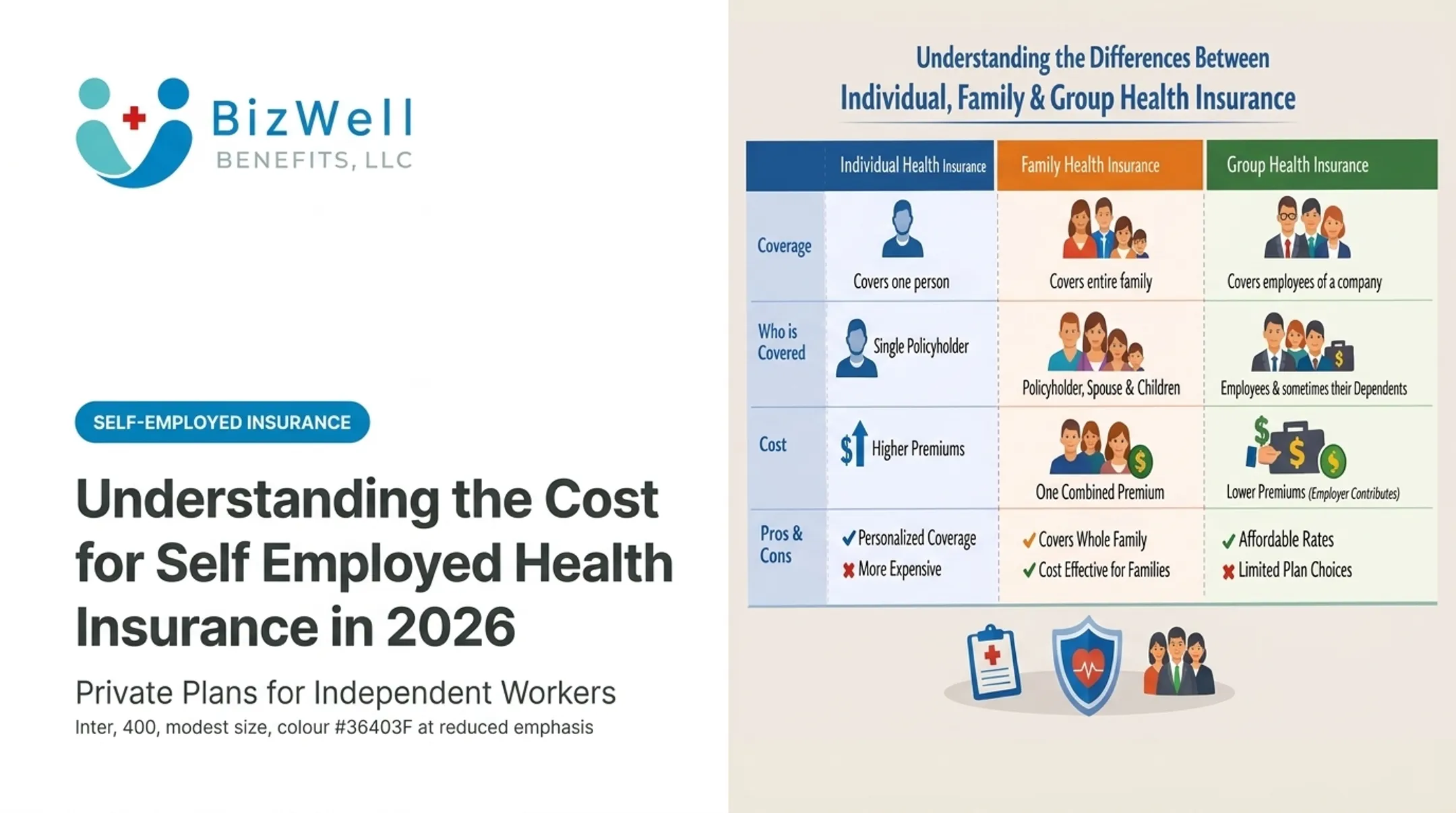
- Spouses are usually part of the same Marketplace tax household and can apply together for family coverage
- Domestic partners may or may not count as household members, depending on state and plan rules
- Unrelated business co-owners are not a tax household just because they share a company
What Affects Your Coverage and Tax Treatment
A few variables determine your options:
- Your partnership structure (general partnership, LLC taxed as a partnership, etc.)
- Each partner's earned income for the year
- State of residence
- Whether either partner has access to another employer-sponsored plan
One common mistake is assuming a business group plan treats owners the same as employees. Always confirm the plan's eligible-class language before assuming you qualify for group coverage as an owner.
Partnership tax reporting also differs from sole-proprietor reporting. Confirm your classification with a tax professional before you choose a coverage path.
Health Insurance Options for Self-Employed Partners
Once you know how the IRS and Marketplace classify your situation, the actual shopping begins. Here's where self-employed partners typically look.
Marketplace and Private Plan Routes
The federal or state Marketplace offers individual and family plans. Depending on household income, you may qualify for premium tax credits or cost-sharing reductions that lower deductibles and copays. Eligibility and thresholds change yearly, so check HealthCare.gov before relying on last year's numbers.
Private plans purchased directly from an insurer or through a broker are the other major route. These can offer:
- Broader PPO network access
- Different plan designs than what's on the Marketplace
- Off-Marketplace options that may fit better if you don't qualify for subsidies
Shared Policy or Separate Policies?
This is where relationship status really matters. Spouses who meet an insurer's definition of eligible household members can often share one family policy. Unrelated business partners generally cannot. Each person typically needs a separate application, even if you run the same company together.
Other Coverage Routes Worth Checking
Depending on your circumstances, you might also have access to:
- Spouse or domestic partner employer plan: often the simplest, most affordable option when available
- COBRA: temporary coverage after leaving a job, usually at the full unsubsidized premium
- Medicaid or CHIP: public coverage that varies by state, household size, and income
- Medicare: generally starts at 65; a spouse's group plan can delay enrollment without penalty
- Group health insurance: possible if the partnership can sponsor a plan; confirm owner participation rules first

Comparing these paths is easier with clear, personalized guidance. BizWell Benefits helps self-employed professionals review private plans and nationwide PPO options across multiple carriers. Consultations are free and no-pressure, with no eligibility or savings promises before your situation is reviewed.
How Much Does Health Insurance Cost for Self-Employed Partners?
Cost is where most self-employed partners get surprised. The monthly premium is only one piece; deductibles, copays, and out-of-pocket limits shape what you actually pay.
What Drives Your Premium
Several factors move the number up or down:
- Age and location (rates vary by county, not just state)
- Tobacco use
- Household size and number of people covered
- Plan type and metal tier (Bronze, Silver, Gold)
- Whether you qualify for income-based assistance
Marketplace average deductibles hit a record high heading into 2026, climbing from $2,759 to $3,786, a 37% jump in a single year, according to KFF's 2026 Marketplace analysis. That's a meaningful shift if you're budgeting from last year's numbers.
Premiums themselves still vary widely by age, county, and household size, so budget against total annual cost—premiums plus deductible exposure—not the monthly quote alone. Private plans outside the Marketplace also price differently, which is why partners often compare both paths before enrolling.
Premium, Deductible, Copay, Coinsurance — In Plain Terms
| Term | What It Means |
|---|---|
| Premium | Fixed monthly payment, whether you use care or not |
| Deductible | Amount you pay before the plan starts sharing costs |
| Copay | Flat fee for a specific service |
| Coinsurance | Percentage you pay after the deductible |
| Out-of-pocket max | Most you'll pay in a plan year for covered, in-network care |
A quick example: Plan A costs $350/month with a $7,500 deductible. Plan B costs $650/month with a $2,500 deductible. Plan A saves you $3,600 a year in premiums alone. But if you need surgery or ongoing treatment, Plan B's lower deductible can cost less overall.

The ACA's 2026 out-of-pocket maximum is capped at $10,600 for individuals and $21,200 for families. That figure is your real worst-case exposure for covered, in-network care—not the premium.
Networks and Benefits That Actually Matter
Before enrolling, check whether the plan covers:
- Both partners' current doctors and specialists
- Prescription formularies for any ongoing medications
- Maternity, mental health, and chronic-condition benefits if either partner needs them
- Telehealth and preventive care
A PPO typically gives broader access without referrals, which matters if you and your partner see different specialists or split time between cities.
Tax Considerations for Partners
Partnership tax treatment for health insurance works differently than most self-employed people expect, mostly because partners aren't W-2 employees.
The Self-Employed Health Insurance Deduction
Partners may be able to deduct medical, dental, and qualifying long-term-care premiums using Form 7206, reported on Schedule 1 of Form 1040.
There's a catch: if you were eligible for a subsidized plan through an employer, a spouse's employer, or a dependent's employer for a given month, premiums for that month generally don't qualify, even if you turned that coverage down.
Guaranteed Payments and K-1 Reporting
Here's where partnerships diverge from sole proprietorships. If a partner pays for their own policy, the partnership typically needs to reimburse them and report that premium as a guaranteed payment on the partner's Schedule K-1.
According to IRS Publication 541, partnership-paid health premiums for partners are treated as guaranteed payments. They are deductible by the partnership, but included in the partner's gross income.
The premium doesn't disappear as a tax-free perk. It flows through as income first, then gets deducted separately on the partner's personal return.
What the Deduction Does — and Doesn't — Do
A few important limits:
- The deduction reduces adjusted gross income, not self-employment tax
- It cannot exceed the partner's earned income from the business establishing the plan
- Multiple businesses require separate calculations
Keep these records: premium invoices, proof of payment, reimbursement paperwork, K-1s, and documentation of any other coverage eligibility.
Your coverage decision and your tax-reporting decision are related but separate. Confirm your specific filing treatment with a tax professional familiar with partnerships and multi-member LLCs.
How Partners Should Compare and Apply for Coverage
With the options and tax mechanics covered, here's how to move through the process.
Before you request quotes, gather:
- Each partner's age, residence, and expected income
- Household members and dependents
- Current doctors, prescriptions, and ongoing treatments
- Preferred hospitals and travel patterns
- Monthly budget and business entity classification
When comparing plans, look past the premium:
- Review the Summary of Benefits and Coverage for each plan side by side
- Check the provider directory for every doctor either partner sees regularly
- Confirm the prescription formulary covers current medications
- Read exclusions, waiting periods, and cancellation terms
- Decide on a shared policy or separate plans using eligibility, deductible structure, and subsidy differences

Separate plans often make more sense when partners have very different medical needs, or when only one partner qualifies for meaningful subsidies.
Once you've picked a plan:
- Submit accurate income and household information
- Verify the network one more time
- Calendar your renewal date so it doesn't sneak up on you
If your business income varies month to month, or you're dealing with a partnership reimbursement arrangement, a second set of eyes is worth it. BizWell Benefits runs this kind of comparison regularly with self-employed clients, reviewing actual usage patterns rather than guessing.
Frequently Asked Questions
What is the best way for self-employed partners to get health insurance?
There's no single best route. It depends on relationship status, income, medical needs, and where you live. Compare Marketplace subsidies, private individual plans, a spouse's employer plan, and small-group options before you enroll.
Can self-employed partners join a spouse's employer health plan?
Often yes, if the employer plan allows spousal or partner dependents and you enroll during open enrollment or a qualifying life event. Compare the employer's premiums and network with private and Marketplace quotes before you drop other coverage.
Should self-employed partners use the Marketplace or a private plan?
Use the Marketplace when subsidy savings are strong; consider private plans when you want broader PPO access or year-round enrollment. An independent broker can compare carriers side by side so you are not locked into one insurer's pitch.
What types of insurance are required for self-employed partners?
Health coverage is not required at the federal level, though some states still run their own mandates and penalties. Confirm your state's rules and whether you and your partner qualify for a small-group plan before you buy.