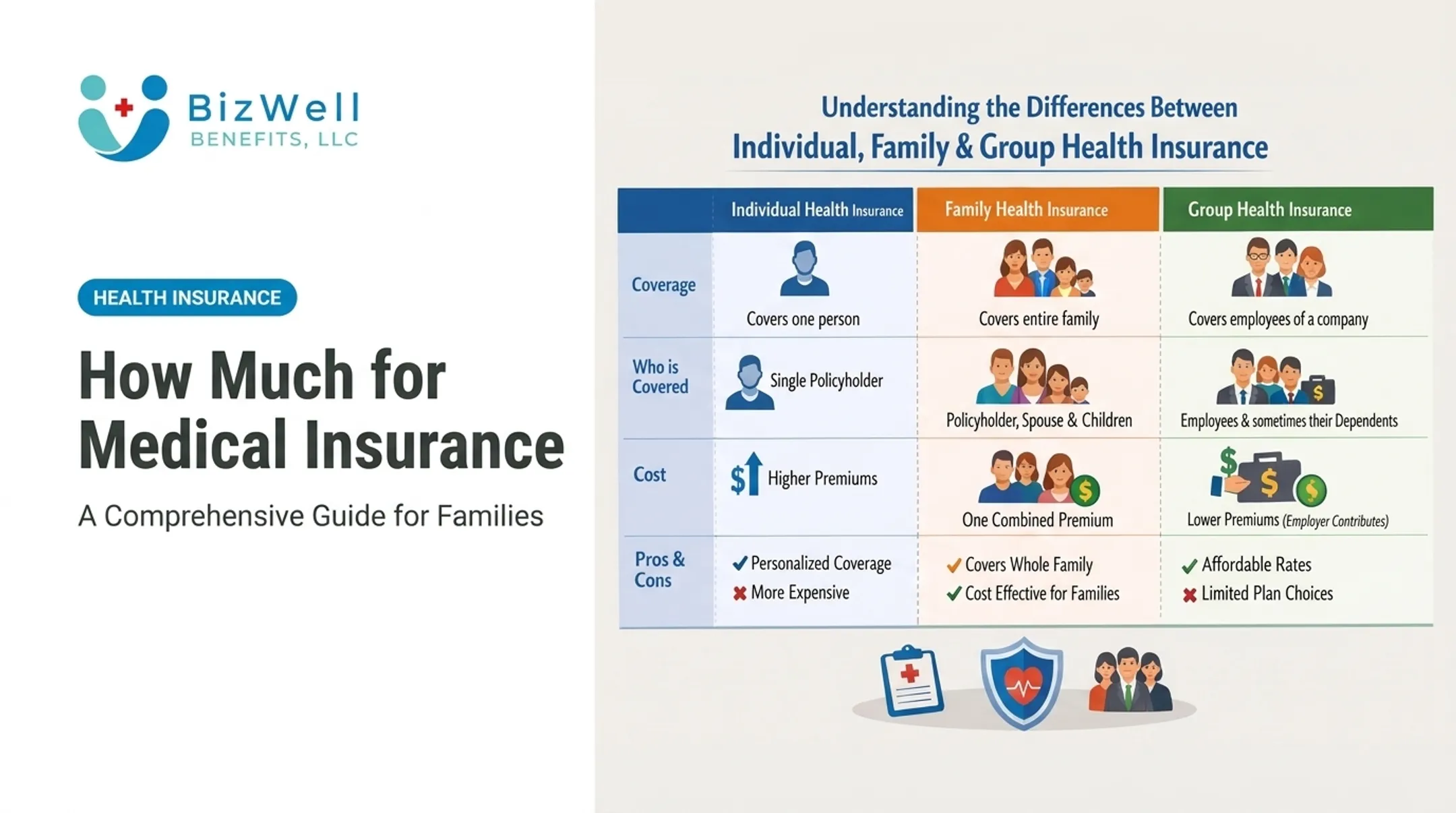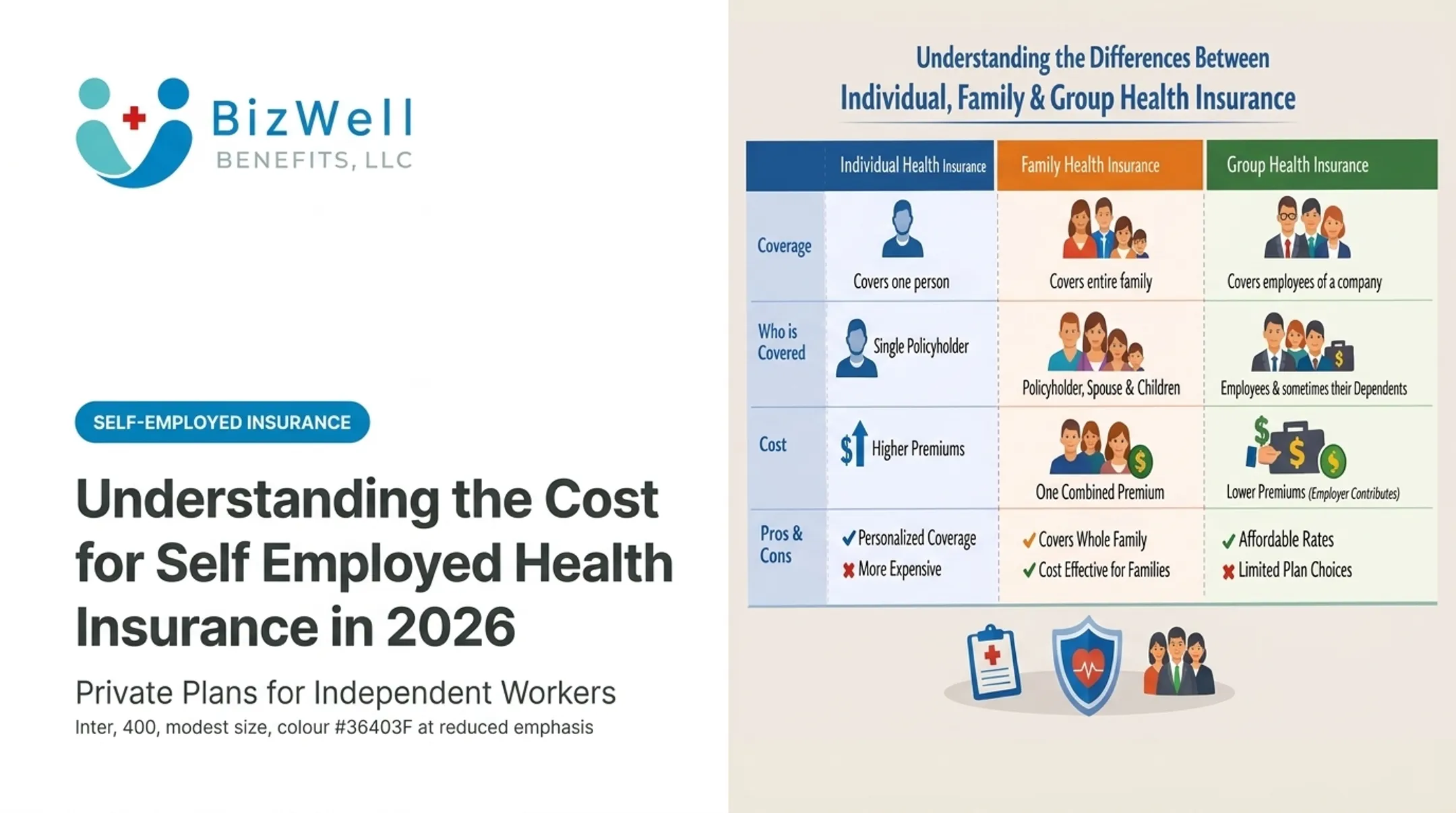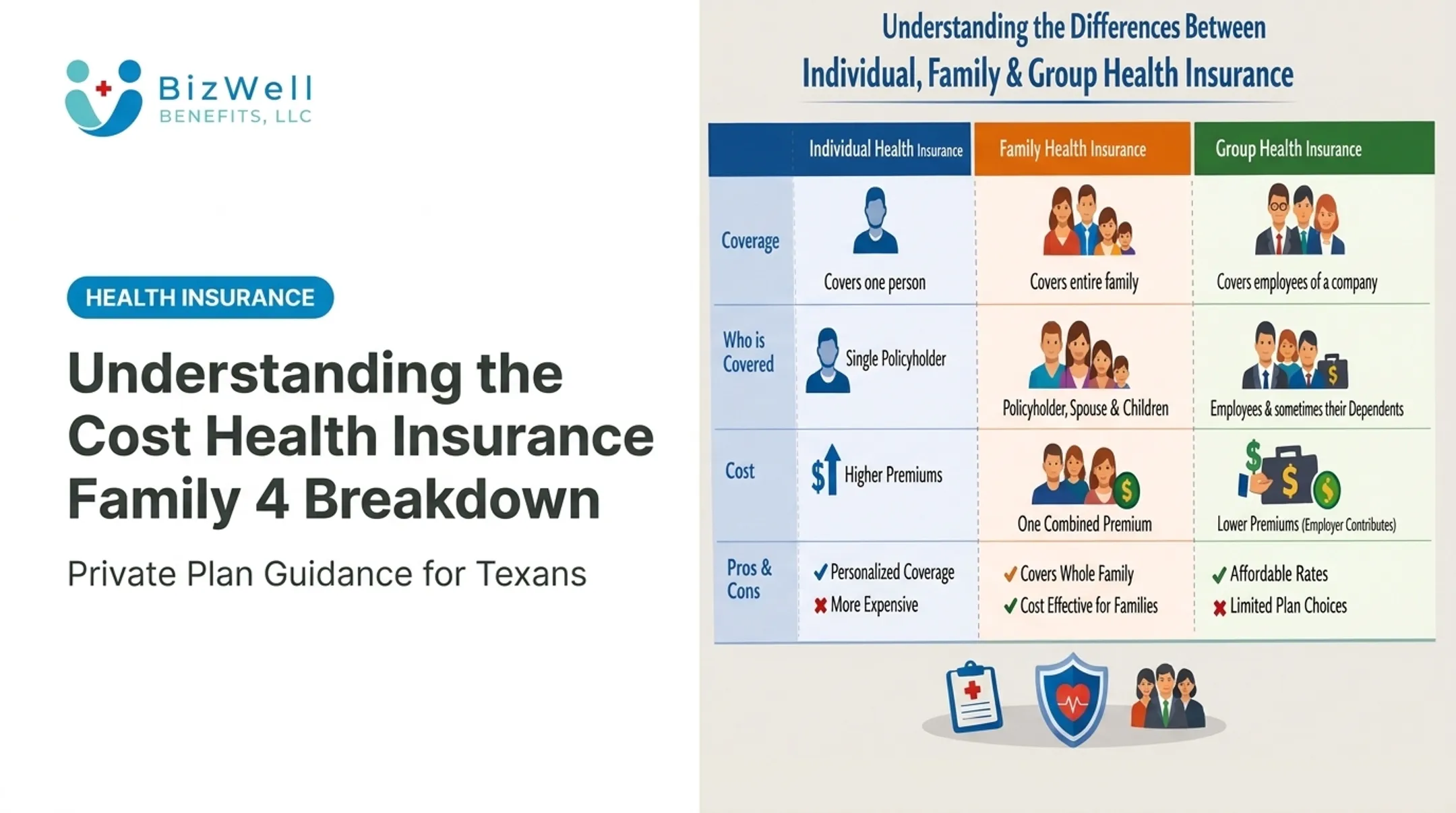

Introduction
Ask five families what they pay for health insurance and you'll get five different answers. A national average sounds helpful, but it rarely matches what shows up on your actual bill.
Coverage source matters more than most people realize. A family on an ACA Marketplace plan pays differently than one on employer benefits, and both differ from families buying private coverage outright.
For context, employer-sponsored family coverage averaged $26,993 a year in 2025—about $2,249 a month in total premium—with workers contributing an average of $571 a month, according to KFF's 2025 Employer Health Benefits Survey.
This guide walks through what families actually pay in 2026:
- Pricing by coverage type (employer, Marketplace, and private)
- Factors that raise or lower your premium
- What a monthly payment really covers
- How to set a realistic family insurance budget
Key Takeaways
- Family premiums vary by coverage source, household size, ages, location, plan tier, and subsidies
- Judge total cost: monthly premium plus deductibles, copays, coinsurance, and the out-of-pocket maximum
- Medicaid, CHIP, and subsidized Marketplace plans can lower monthly costs for eligible households
- Employer and private off-Marketplace plans often mean richer benefits at a higher monthly premium
- The 2026 family out-of-pocket maximum is capped at $21,200 for in-network covered care
How Much Does Family Health Insurance Cost Per Month in 2026? (Pricing Overview)
There's no single "family premium" for 2026. Pricing depends on how many people are covered, their ages, your state, tobacco use, the metal tier you pick, and whether you qualify for financial help. Any number you see online is an illustration, not a personal quote.
Here's what the most reliable 2026 benchmarks show:
| Coverage type | What's reported | Monthly figure |
|---|---|---|
| ACA Marketplace, lowest-cost eligible plan | After tax credits, not family-specific | $50 (CMS estimate) |
| Employer-sponsored family plan, total premium | 2025 data, full premium | $2,249.42 |
| Employer-sponsored family plan, employee share | 2025 data, worker's portion | $570.83 |
| Marketplace enrollee, average net payment | 2026, individual, not family-specific | $178 |
The CMS Plan Year 2026 Marketplace Plans and Prices Fact Sheet projects tax credits will cover roughly 91% of premiums for the lowest-cost eligible plan. That figure applies to individual enrollees, not household totals.
Illustrative scenarios (estimates only, not quotes):
- Family of four, subsidized Marketplace Silver plan: Net premium could range from under $200 to over $900/month depending on income and location
- Couple with one child, employer plan: Employee contribution might land near the $571/month national average, with the employer covering the rest
- Self-employed parent, private PPO plan: A 35-year-old parent in Houston recently received quotes from $380 to $690 a month for comparable private plans, depending on carrier and plan design

Public coverage changes the math entirely. Medicaid and CHIP eligibility (generally at or below 138% of the federal poverty level for adults, and higher thresholds for children) can mean very low or zero monthly premiums. For 2026, the federal poverty level is $33,000 for a family of four, according to HealthCare.gov.
Full premium, employee share, and after-subsidy payment are three different numbers. Confusing them is the fastest way to misjudge your budget.
What Factors Change a Family's Monthly Health Insurance Cost?
Insurers set premiums using rules that apply to everyone in a rating area. Subsidies and employer contributions, however, only affect what your household actually pays. Both layers matter.
Family size and ages
Every additional person on the plan adds premium cost, since each covered individual represents potential claims. Older adults generally cost more than younger ones.
Under federal age-rating rules, a 64-year-old typically can't be charged more than three times the premium of a 21-year-old—the 3:1 age band—per CMS market rating reform guidance.
Location and household circumstances
Where you live changes your price more than most people expect. State regulations, local provider costs, and carrier competition all factor in. KFF's 2026 data shows a 40-year-old's benchmark Silver plan running around $645/month in Alabama versus roughly $1,032/month in Alaska. That's not a personal quote, just proof that geography swings pricing significantly.
Tobacco use and your specific rating area within a state can move the number further.
Coverage level and plan design
Metal tiers describe how costs split between you and the insurer, not the quality of care you receive:
- Bronze: Plan pays 60%, you pay 40% (lower premium, higher deductible)
- Silver: Plan pays 70%, you pay 30%
- Gold: Plan pays 80%, you pay 20%
- Platinum: Plan pays 90%, you pay 10% (higher premium, lower deductible)
- Catastrophic: Available to some under-30 enrollees or those with hardship exemptions

Network type matters too. Available pricing data shows PPO plans averaging around $517/month versus $427/month for HMO plans. PPOs allow specialist visits without referrals and cover a share of out-of-network care; HMOs generally restrict you to an in-network provider list and require referrals for specialists.
Income, subsidies, and employer contributions
Household income drives Marketplace subsidy eligibility. In 2026, premium tax credits remain available to households earning 100% to 400%+ of the federal poverty level, per HealthCare.gov.
The IRS set the 2026 required contribution percentage at 9.96% under Revenue Procedure 2025-25. That percentage helps determine whether an employer plan counts as "affordable" for Marketplace eligibility.
If your employer's plan already meets ACA affordability and minimum-value standards, you generally won't qualify for Marketplace subsidies, even if the employee contribution feels steep.
Health needs and optional coverage
Expected prescriptions, specialist visits, maternity care, chronic-condition management, and behavioral health needs won't necessarily change your medical premium, but they do change your total budget.
Dental and vision aren't typically bundled into standard health plans. If you want them, confirm whether they're add-ons or separate policies, and factor those premiums into the household total before you enroll.
What Does the Monthly Premium Actually Cover?
Your premium keeps the policy active. That's it. It doesn't shrink your deductible or eliminate copays when you actually use care.
Premiums and deductibles
The premium is your recurring monthly payment, locked in for the plan year once you enroll. The deductible is what you pay out of pocket before the plan starts sharing costs. Family plans typically layer two deductibles: an individual deductible embedded for each covered person, and an aggregate family deductible cap.
Consider two hypothetical plans:
- Plan A: $350/month premium, $7,500 deductible
- Plan B: $650/month premium, $2,500 deductible

Plan A looks cheaper monthly, but a single ER visit or surgery could leave you covering thousands more before benefits kick in.
Copayments, coinsurance, and prescriptions
Premiums alone don't tell you what you'll pay at the point of care. Three other charges usually show up first:
- Copays: Fixed fees for office visits or prescriptions, often due even before the deductible is met
- Coinsurance: Your share after the deductible—for example, you pay 20% while the plan pays 80% of the allowed charge
- Pharmacy tiers: Brand-name drugs often cost far more than generics once you move up the formulary
Out-of-pocket maximum and total annual exposure
The out-of-pocket maximum is your financial ceiling for the year, but it comes with exclusions. For 2026, that limit is no more than $21,200 for a family plan and $10,600 for an individual, per HealthCare.gov's out-of-pocket maximum guidance.
Once you hit it, the plan covers 100% of covered in-network services for the rest of the year.
What it excludes:
- Monthly premiums
- Services the plan doesn't cover
- Out-of-network care
- Amounts above the plan's allowed charge
Skip this exclusion list at your own risk. Plenty of families assume the out-of-pocket max protects them from every bill, then get surprised by an out-of-network specialist charge.
How to Estimate the Right Family Health Insurance Budget
Guessing your family's health insurance budget rarely ends well. A structured approach works better.
- List everyone needing coverage: spouse, kids, dependents, and their approximate healthcare needs
- Check employer options first: if available, compare the employee contribution against Marketplace or private alternatives
- Estimate household income: this determines Medicaid, CHIP, or premium tax credit eligibility
- Multiply the monthly premium by 12: then add a realistic allowance for deductibles, copays, and prescriptions, plus roughly 5% for cost inflation
- Compare at least three plans side by side: same assumptions, same categories: premium, deductible, out-of-pocket max, network, and drug coverage

Run a worst-case check: add the annual premium to the plan's in-network out-of-pocket maximum. That combined number is your planning ceiling, not a prediction, but it tells you what you could owe in a bad year.
Before committing, ask:
- Are our doctors, hospitals, and pharmacies in network?
- Are recurring prescriptions covered at an affordable tier?
- Does the plan support care if we travel or move?
- Are maternity, pediatric, mental health, and preventive services covered as expected?
- Could we actually afford the deductible if a major claim hit tomorrow?
If the comparison feels overwhelming, an independent broker can help.
BizWell Benefits compares options across multiple carriers, explains network and cost-sharing differences in plain terms, and offers a free, no-pressure consultation for families weighing employer, Marketplace, or private coverage.
What Families Often Miss When Comparing 2026 Health Insurance Costs
Even careful shoppers fall into predictable traps. Watch for these:
- Fixating on the premium alone: the monthly number means little without deductibles, copays, coinsurance, and the out-of-pocket max factored in
- Assuming "lowest premium" equals "cheapest overall": frequent specialist visits or a planned procedure can flip that math fast
- Missing enrollment windows: declining employer coverage outside open enrollment can lock you out of both employer and Marketplace options until a qualifying life event
- Skipping network and formulary checks: a provider showing up in a general carrier search doesn't guarantee they're in your specific plan's network
- Confusing short-term plans with ACA-compliant coverage: these plans can bridge a gap between jobs, but they often skip pre-existing condition protections and mental health or prescription coverage that ACA plans guarantee
That last point deserves emphasis. Short-term plans are a stopgap, not a substitute. If a family relies on one for months rather than weeks, gaps in coverage tend to surface exactly when they're least affordable.
Conclusion
There's no universal answer to "how much is family health insurance per month in 2026." The real answer depends on your coverage source, household size and ages, plan design, income-based subsidies, and any employer contribution.
The comparison that actually protects your budget looks at monthly premiums and potential annual medical spending together, not the premium in isolation.
Start by gathering a few household details:
- Who needs coverage
- Expected healthcare use
- Your realistic monthly budget
Compare a few plans using the same categories. When network rules, subsidy eligibility, or private-plan differences get confusing, a licensed broker can walk through the details with you.
BizWell Benefits offers free consultations for families comparing employer, Marketplace, or private options across Texas and most U.S. states.
Frequently Asked Questions
What is the average cost of health insurance per month in the US?
There's no single 2026 national average that applies to every household. Marketplace enrollees paid an average net premium of $178/month in 2026, but that figure covers individuals with and without subsidies, not families.
What is a typical monthly health insurance premium?
Premiums vary widely by household size, age, location, network type, and subsidy eligibility. Rather than relying on a national average, compare quotes based on your own household's specific details.
How much does the average US family pay for health insurance per month?
Families with employer-sponsored coverage contributed an average of $570.83/month toward a total premium of $2,249.42/month in 2025. Marketplace and private-plan costs differ and depend heavily on subsidy eligibility and plan choice.
Can I pay for health insurance monthly?
Yes. Most Marketplace and private plans bill monthly, while employer plans typically deduct your share directly from each paycheck. Missing payments can lead to a grace period and eventual termination, so keep payments current to avoid a coverage lapse.
Is it worth paying for private health insurance?
It depends on your provider-access needs, budget, and whether you qualify for subsidies elsewhere. Private plans can offer broader networks and year-round enrollment, but they don't include Marketplace subsidies, so weigh cost against flexibility.
What is the best age to buy health insurance?
There's no perfect age, since ACA-compliant plans can't price coverage based on health status or deny you for pre-existing conditions. Enrolling before a medical need arises still avoids gaps in care, so check your eligibility windows early.