
Introduction
Choosing health coverage usually comes down to one practical question: does your employer's group plan actually serve you better than buying your own? Group coverage often means shared costs and one-click enrollment. Individual coverage often means more choice and a policy that doesn't disappear the day you quit.
This decision affects employees, families, self-employed professionals, contractors, and small-business owners differently.
The 2025 average annual premium for employer-sponsored coverage reached $9,325 for single coverage and $26,993 for family coverage, according to KFF's 2025 Employer Health Benefits Survey. Those figures show why the group-versus-individual choice hits real household budgets.
We'll compare eligibility, employer contributions, plan flexibility, provider networks, enrollment timing, and total household costs. Plan rules vary by state, so verify current details before you enroll.
Key Takeaways
- Group plans are employer-selected; individual plans are purchased directly by you or your family.
- Employer contributions can lower your monthly cost, but plan choice is limited.
- Individual coverage travels with you between jobs and may qualify for premium tax credits.
- The right choice depends on total annual cost, not just the premium sticker price.
- BizWell Benefits helps compare both paths across multiple carriers at no cost.
Group Health Insurance vs. Individual Health Insurance: Quick Comparison
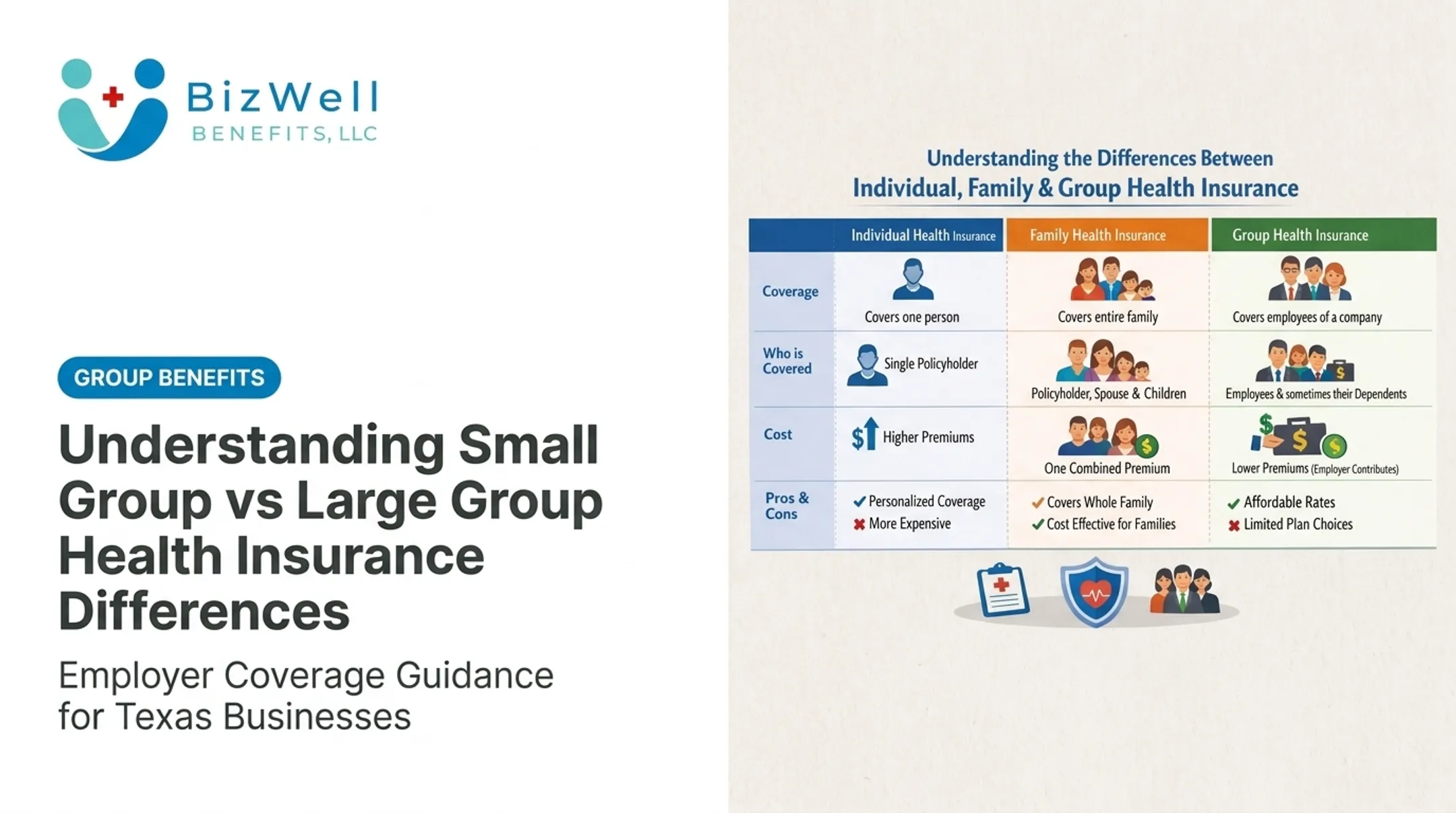
An employer or qualifying organization arranges group insurance for its workforce. An individual or family selects and enrolls in their own plan through the Marketplace, an insurer, or a licensed broker.
Cost and Payment
Group: Premiums are typically shared. Your payroll deduction is only your slice of the total cost. KFF reports workers paid 16% of single premiums and 26% of family premiums in 2025, with employers covering the rest.
Individual: You pay the premium directly. Marketplace enrollees earning between 100% and 400% of the federal poverty level may qualify for a premium tax credit that lowers monthly costs. Eligibility rules can shift year to year, so confirm current guidance before assuming you qualify.
Plan Choice and Networks
- Group: Coverage is limited to what the employer negotiated—one carrier, maybe two tiers, plus a fixed network and formulary.
- Individual: You compare metal tiers, deductibles, and networks yourself, plus optional add-ons where available.
Portability
- Group: Coverage ends when your job does, subject to COBRA continuation.
- Individual: Coverage isn't tied to any employer, though changes outside open enrollment require a qualifying life event.
Total Value
Don't stop at the premium. Compare the full picture:
- Deductibles, copays, and coinsurance
- Out-of-pocket maximums
- Dependent costs and employer contributions
A cheaper monthly bill can still cost more over a full year of actual care.

What Is Group Health Insurance?
Group health insurance is coverage an employer or qualifying organization arranges for a defined set of employees, often including eligible dependents. The employer picks the carrier and plan options, sets eligibility and contribution rules, and employees enroll during the plan's window or after a qualifying life event.
Because the employer negotiates on behalf of a whole workforce, risk pooling can lower per-person costs. Actual affordability still depends on the plan design, contribution level, and how many dependents you're covering.
Common employee benefits:
- Simplified, guided enrollment
- Pre-tax payroll deductions in most cases
- Access to employer-selected provider networks
- Bundled options like dental, vision, or wellness perks where offered
The tradeoffs are real, though. You typically have little say over the carrier, network, formulary, or deductible structure. And if you leave the employer, that coverage usually leaves with the job.
Use Cases of Group Health Insurance
Group coverage tends to fit best when the employer contribution makes your share genuinely affordable, and the plan's doctors, hospitals, and prescriptions line up with what your household actually uses.
Small-business owners often look at group plans to support hiring and retention. Federal rules define an Applicable Large Employer as one averaging at least 50 full-time employees in the prior year, per the IRS, which affects compliance obligations.
Smaller employers face fewer federal mandates but should still review participation and contribution requirements before committing.
A quick evaluation checklist for small-business owners:
- Set a monthly budget you can sustain through renewal cycles, not just this year.
- Review workforce demographics: ages, dependents, chronic conditions.
- Decide your employee contribution strategy upfront.
- Confirm administrative capacity for enrollment and renewals.
- Check whether dependent coverage is included or optional.
Comparing carriers side by side gets complicated fast. BizWell Benefits works with small-business owners across Texas to compare group health plans across multiple carriers and match coverage to both budget and workforce needs, with no guaranteed savings promised upfront, just a clearer picture of the options.
What Is Individual Health Insurance?
Individual health insurance is coverage purchased by a person or family rather than provided through an employer. Depending on the plan and state, you can buy it through the federal or state Marketplace, directly from an insurer, or with help from a licensed broker.
Why people choose it:
- Full control over plan selection
- Coverage tailored to actual household needs
- Portability through job changes or self-employment transitions
You'll generally pay the full premium yourself, though Marketplace enrollees may qualify for financial assistance. Marketplace plans cannot deny coverage or charge more because of a pre-existing condition, a protection worth knowing about if you've had gaps in coverage before.
What to Compare When Selecting a Plan
- Metal tier (Bronze, Silver, Gold, Platinum) where applicable
- Premium, deductible, copays, coinsurance, and out-of-pocket maximum
- Provider network and prescription formulary
- Maternity coverage and specialist access
- Travel or out-of-area care needs

Open Enrollment for ACA Marketplace plans generally runs from November 1 through January 15, though states can set their own windows. Outside that window, you'll need a qualifying life event, such as marriage, a new baby, or losing other coverage, to enroll through a Special Enrollment Period.
Those enrollment rules matter most once you know whether individual coverage fits your situation.
Use Cases of Individual Health Insurance
Individual coverage tends to make the most sense for:
- Self-employed professionals and contractors
- Part-time workers without employer benefits
- Early retirees and people between jobs
- Employees whose workplace plan doesn't fit their needs
Families should compare a household plan against separate individual policies. Check dependent premiums, pediatric care access, prescription coverage, and whether each person's preferred providers are in-network.
KFF's 2024 data shows individual-market coverage averaged $540 per member per month, compared to $587 per member per month for fully insured employer coverage. Those figures are national averages, not a quote for your household.
When you compare plans, weigh annual premium plus likely out-of-pocket costs—not the monthly price alone.
BizWell Benefits helps individuals, families, and self-employed professionals compare private health insurance options across carriers, including plan and network differences, with free no-pressure guidance.
Group vs. Individual Health Insurance: Which Is Better?
Neither option wins automatically. Compare the actual plan documents and your household's expected costs against your provider preferences, job stability, and enrollment timing.
Choose Group Health Insurance When
- The employer contribution makes your share, plus dependent costs, genuinely competitive
- The plan already includes your preferred doctors and medications
- The deductible and out-of-pocket maximum fit comfortably in your budget
- Administrative simplicity matters, like automatic payroll deductions and bundled dental or vision options
Choose Individual Health Insurance When
- You're self-employed, between jobs, or not offered employer coverage at all
- You want coverage that survives a job change or business transition
- An individual plan offers a better network, formulary, or total cost, factoring in possible subsidy eligibility
Real-World Decision Scenarios
Employee with strong employer contribution: Compare monthly and annual premiums after the employer's share. Check the deductible, network, and whether preferred prescriptions are covered before assuming the workplace plan wins by default.
Self-employed professional: Weigh subsidy eligibility, provider network breadth, and total annual cost against the flexibility of choosing your own plan.
Family comparing dependent costs: Run the numbers on a household plan versus separate individual policies, factoring in each dependent's care needs and preferred providers.
Small business weighing group vs. reimbursement models: Some employers explore an Individual Coverage HRA (ICHRA) or QSEHRA, which lets a business reimburse employees for individual-market premiums instead of sponsoring a traditional group plan.
Employers can set any contribution amount for these arrangements; there's no federal minimum or maximum. Eligibility, nondiscrimination rules, and tax treatment vary, so verify current federal requirements before choosing this route.
How to Compare Plans Before Enrolling
- Gather the paperwork. Get the Summary of Benefits and Coverage, provider directory, formulary, premium quote, and enrollment deadlines for every option you're considering.
- Check every covered person's needs. Doctors, hospitals, specialists, medications, planned procedures, and behavioral-health access.
- Calculate the full annual cost. Premium plus realistic cost-sharing, not just the monthly number.
- Confirm worst-case exposure. What's the actual out-of-pocket maximum if something goes wrong?
- Verify enrollment eligibility. Open enrollment window, qualifying life events, or employer-specific rules.

Want a second set of eyes on this? BizWell Benefits offers independent, personalized consultations with a licensed healthcare agent to help you compare group or individual options, no pressure, just clarity.
Conclusion
Group insurance leans on shared costs and employer-supported convenience. Individual insurance leans on choice, portability, and control. Neither label tells you which one is right for your household.
Decide based on the actual plan's total cost, network, benefits, and enrollment rules, alongside your employment situation and healthcare needs. The category name matters far less than the numbers on the page in front of you.
Federal and state requirements, subsidy eligibility, and tax rules shift over time. When the decision gets complicated, BizWell Benefits can walk through your options in a free, no-pressure consultation—comparing plans across carriers so you choose on fit and cost, not guesswork.
Frequently Asked Questions
Is group health insurance more expensive?
Not necessarily. Employer contributions can lower your share, but your real cost still depends on premiums, deductibles, and out-of-pocket limits. Compare actual plan documents rather than assuming group coverage always costs less.
Who pays the premium in a group health plan?
Employers and employees typically split the premium, with your portion deducted from payroll. Contribution amounts and dependent coverage rules vary by employer and plan, so check your specific policy.
Is it better to have a family plan or individual plan?
It depends on family size, expected care, provider needs, and each option's total household cost. Compare dependent premiums, deductibles, and out-of-pocket limits across every available choice.
Which is better, individual or group health insurance?
Group coverage usually wins when you want employer premium help and simpler enrollment. Individual coverage fits better when you need portability or a wider choice of plans. Compare both side by side using total annual cost, not premium alone.
What's the difference between individual and group health insurance?
Group insurance is employer- or organization-sponsored coverage for a defined workforce. Individual insurance is coverage you purchase yourself. They differ mainly in payment structure, plan choice, portability, and administration.