
Introduction
Choosing between an individual and a family health insurance plan isn't just about the monthly bill. It determines who's actually covered, how medical costs get split among household members, and what you'll owe if someone ends up in the hospital.
Many people default to whichever option looks cheaper on paper. That's a mistake. The right choice depends on your household size, expected healthcare use, income, eligibility for financial help, and whether everyone's doctors and prescriptions fall under the same network.
This guide breaks down individual and family plans side by side: coverage, premiums, deductibles, out-of-pocket maximums, provider networks, and enrollment rules. We'll also cover when each option tends to make more financial sense. Costs and plan availability vary by state, insurer, and household, so treat the numbers here as examples, not quotes.
TL;DR
- Individual plans cover one person; family plans cover multiple eligible members under one policy.
- Family coverage isn't automatically cheaper than buying separate individual plans.
- Compare premiums, deductibles, out-of-pocket maximums, and networks for every covered person, not just the household total.
- Separate plans can make sense when family members need different doctors, medications, or coverage types.
- An independent broker like BizWell Benefits can help you compare carriers before you enroll.
Individual vs. Family Health Insurance: Quick Comparison
Here's how the two plan types stack up across the factors that actually affect your wallet.
Coverage
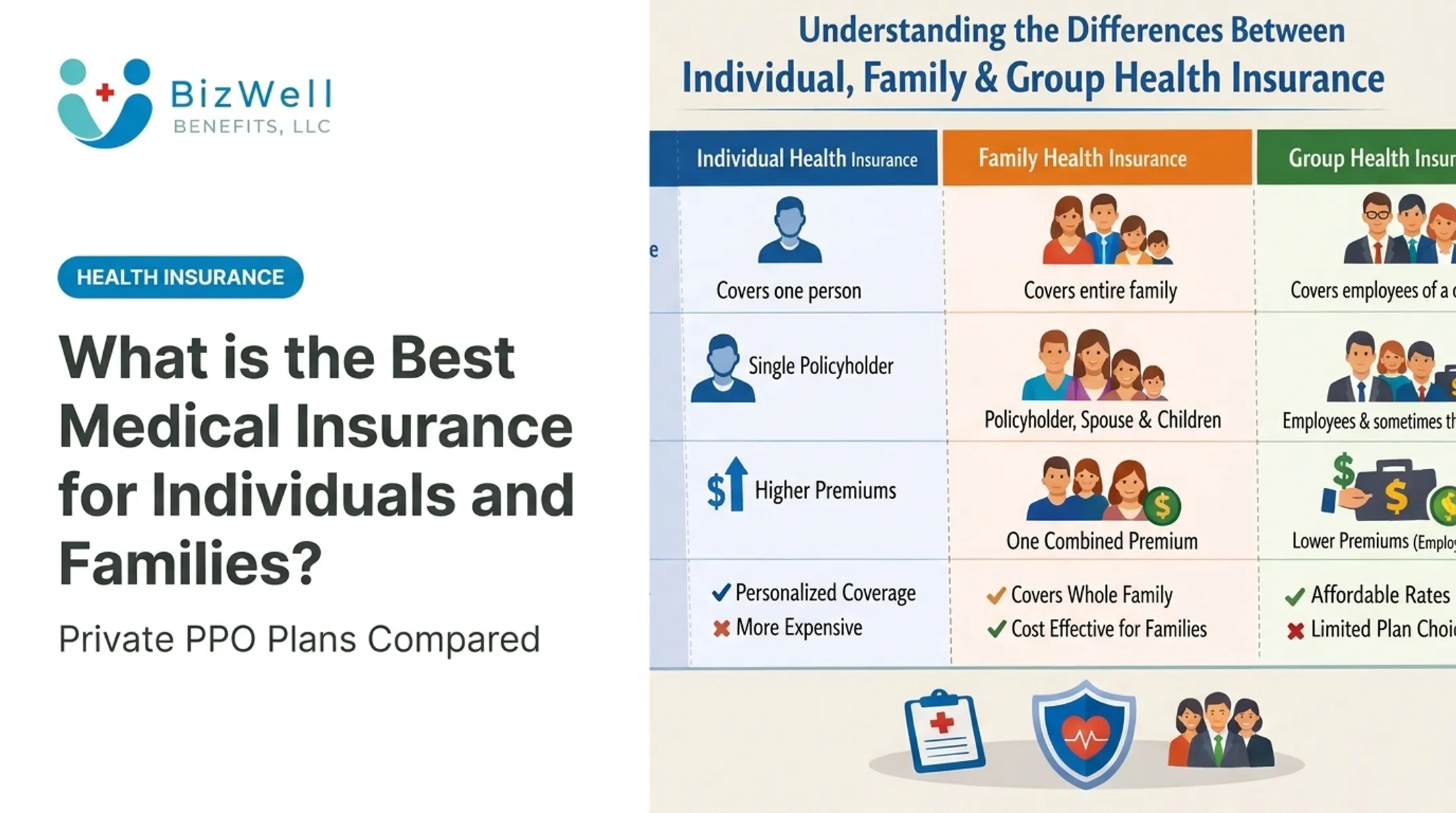
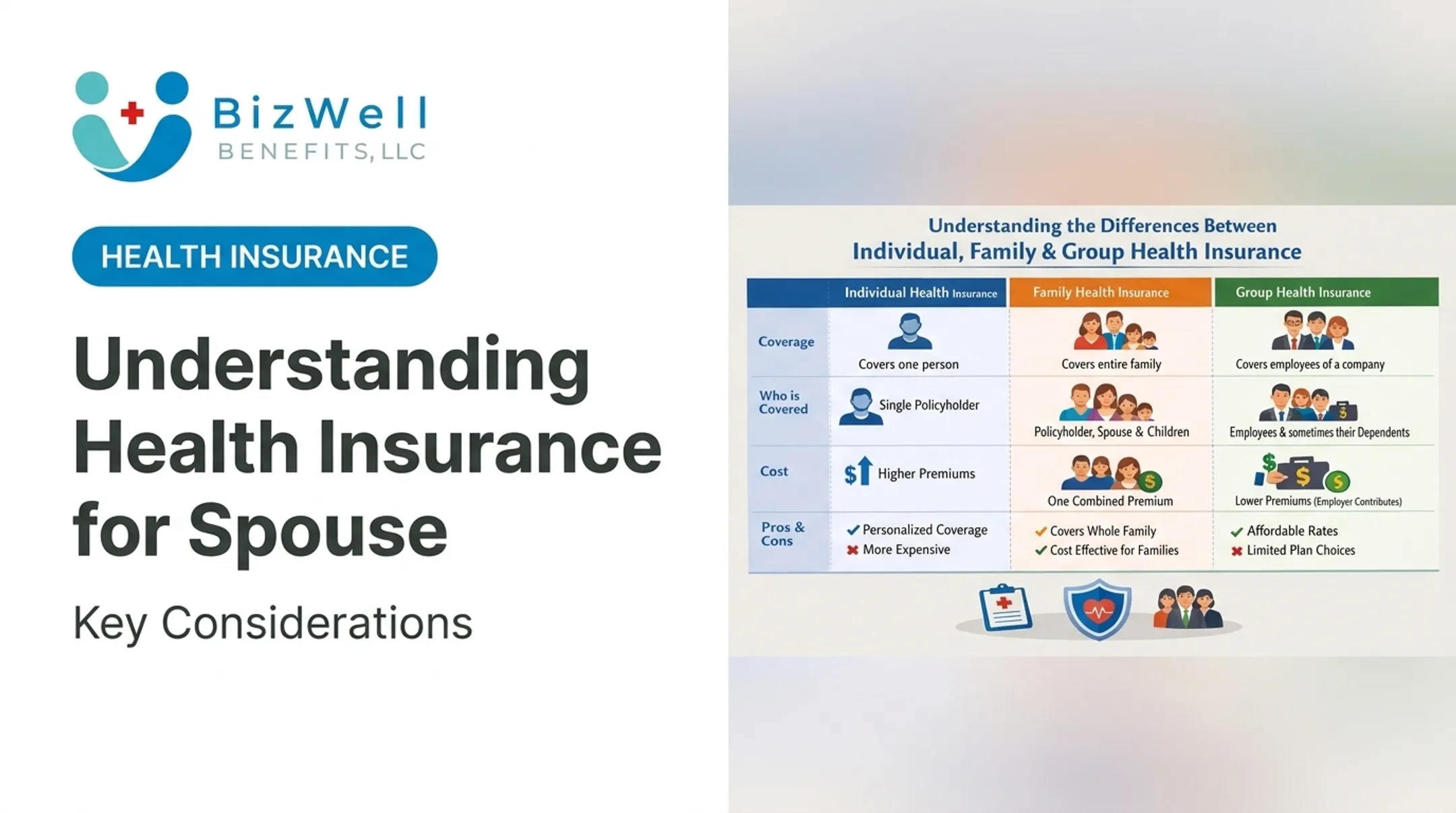
An individual plan is built around one person. It generally won't extend coverage to a spouse, child, or other dependent, even if they live in the same household.
A family plan works differently. Multiple eligible household members, typically a spouse and dependent children, can share a single policy. Coverage still depends on the insurer's eligibility rules and federal and state requirements.
Premiums and Total Cost
Premiums for an individual plan are based on the covered person's age, location, and plan selection, along with eligibility for financial assistance. The only way to know your exact rate is a current quote, since pricing shifts by carrier and ZIP code.
Adding household members to a family plan usually raises the premium. Whether that combined cost is worth it depends on:
- Expected healthcare use across the household
- Eligibility for subsidies or financial assistance
- Deductible and cost-sharing terms on the plan
Deductibles and Out-of-Pocket Maximums
On an individual plan, one person is responsible for meeting the deductible and reaching the out-of-pocket maximum. There's no sharing, because there's only one person on the policy.
Family plans use one of two deductible structures:
- Aggregate deductible: The household's combined medical expenses count toward one shared deductible before cost-sharing kicks in for anyone.
- Embedded deductible: Each member has an individual deductible inside the family deductible. Once someone hits their amount, coinsurance starts for them even if the full family deductible is unmet.
For 2025 ACA-compliant plans, CMS capped the maximum out-of-pocket limit at $9,200 for self-only coverage and $18,400 for family coverage. Your specific plan's limits could be lower than the federal cap.
Networks and Benefits
Shopping for an individual plan is simpler because you're only checking one person's doctors, hospitals, and prescriptions against the network.
Family plans use one network and one formulary for everyone on the policy. What works for one spouse's cardiologist might not include the other spouse's specialist, or a child's pediatrician.
Check every member's providers and medications before enrolling, not just the primary policyholder's.
Administration and Enrollment
Managing an individual plan is straightforward: one set of claims, one renewal date, one member to track.
A family plan bundles everyone under one renewal cycle, which cuts down on paperwork. The tradeoff is extra tracking:
- Dependent eligibility rules
- Qualifying life events such as marriage or a new baby
- Policy updates when someone joins or leaves the household

What Is an Individual Health Insurance Plan?
An individual health insurance plan is a policy purchased by and for one person, separate from employer-sponsored group coverage. You can buy it through the ACA Marketplace or from a private insurer outside the Marketplace, depending on your eligibility and what's available in your state.
Who Typically Buys Individual Coverage
Individual plans tend to fit:
- A single adult without access to employer coverage
- Self-employed professionals and solopreneurs
- Someone between jobs who needs a coverage bridge
- A person whose family members already have separate coverage that suits them better
Why People Choose Individual Plans
The appeal is focus. You're comparing one person's doctors, one prescription list, one set of expected services, so plan shopping stays simpler. You also get more control over plan design, since you're not balancing multiple people's needs at once.
The trade-off: the policy doesn't cover anyone else. If your spouse or kids need insurance, they'll need their own policy, or you'll need a family plan instead.
How to Evaluate an Individual Plan
Before enrolling, compare:
- Monthly premium against your budget
- Deductible and how realistically you'd hit it
- Copays and coinsurance for routine and specialist visits
- Out-of-pocket maximum for worst-case protection
- Provider network to confirm your doctors are covered
- Prescription formulary for any regular medications
A Self-Employed Example
Say a self-employed graphic designer in Texas is weighing two individual plans. Plan A runs $310 a month with a $6,000 deductible. Plan B runs $420 a month with a $2,500 deductible.
Over a year, Plan A costs $3,720 in premiums before any care. Plan B costs $5,040 in premiums. If she only needs routine checkups, Plan A likely wins. If she's expecting a minor procedure or ongoing specialist visits, Plan B's lower deductible could mean less total spending once cost-sharing is factored in. Compare both scenarios against the care you actually expect—not just the sticker premium.
An independent broker like BizWell Benefits can walk you through those trade-offs across carriers at no cost, so you enroll with clear numbers instead of guesswork.
What Is a Family Health Insurance Plan?
A family health insurance plan covers multiple eligible household members, typically a policyholder plus spouse and dependent children, under one policy. Eligibility rules vary by insurer and are shaped by federal and state law.
Under the ACA, plans that offer dependent coverage generally must let a child stay on a parent's plan until age 26, regardless of marital status, residence, student status, or tax-dependent status. Marketplace coverage can continue through December 31 of the year the child turns 26, depending on the state and plan.
One Policy, Different Costs Per Person
A shared policy doesn't mean shared healthcare needs. One spouse might rarely see a doctor while the other manages a chronic condition. A family plan bundles coverage administratively, but each member still generates their own claims and costs.
How Family Deductibles Actually Work
Family plans typically use one of two structures. With an aggregate deductible, the family must collectively spend the full deductible amount before cost-sharing starts for anyone. With an embedded deductible, each member has a smaller deductible built into the family total.
For example, a plan might set a $3,000 individual deductible inside a $6,000 family deductible. If one member reaches $3,000, that person moves to coinsurance immediately, even though the household hasn't hit the full $6,000. The same logic often extends to the out-of-pocket maximum.

When a Family Plan Makes Sense (and When It Doesn't)
A family plan usually fits when:
- Multiple household members need similar coverage levels
- One network covers everyone’s doctors, hospitals, and prescriptions
- The combined premium beats buying separate policies
Reconsider a family plan when:
- Premiums stack up higher than expected once every member is added
- A family member's preferred doctor or medication doesn't fit the shared network well
- Household members qualify for very different coverage types, such as one person eligible for a subsidized plan and another for employer coverage
Individual vs. Family: Which Is Better?
Neither option wins by default. The better choice comes down to your household's total expected cost, coverage needs, eligibility, and provider access for the coming plan year.
Choose individual plans (or separate individual policies) when:
- Only one person in the household needs coverage
- Family members qualify through different sources
- Household members need substantially different networks, prescriptions, or plan designs
Consider a family plan when:
- Multiple eligible members need coverage
- One network realistically meets everyone's needs
- The combined cost-sharing terms are acceptable once you run the numbers
Weighing Low- vs. High-Deductible Options
A lower deductible generally comes with a higher monthly premium, and vice versa. Weigh that trade-off against expected medical spending, prescription needs, planned specialist visits, maternity care if it applies, and the plan's out-of-pocket maximum.
If an HSA-qualified high-deductible plan is on the table, check current IRS contribution limits before assuming it's the cheaper route. The math depends on how much you actually spend.
A Quick Decision Checklist
- Confirm each household member's doctors and facilities are in-network
- Check prescription formularies for anyone on regular medication
- Compare premiums against realistic annual cost exposure, not just the monthly rate
- Review deductibles and out-of-pocket limits for every plan under consideration
- Verify subsidy or tax-credit eligibility if shopping the Marketplace
- Confirm enrollment deadlines for your state and plan type

Two Quick Scenarios
A couple with different needs: One spouse is healthy and rarely visits a doctor. The other manages a chronic condition and sees a specialist quarterly. Separate individual plans let the healthy spouse pick a leaner, cheaper plan while the other builds coverage around their specialist's network and medication list.
A family of four with young kids: Both parents work, and the kids need regular pediatric visits plus occasional urgent care. A family plan with strong nationwide PPO access likely beats juggling four separate policies, as long as the combined premium still compares favorably to buying separately.
In both cases, the deciding factor isn't the plan label. It's whether the numbers and the network actually fit the household.
If you want help comparing carriers or understanding how nationwide PPO networks differ from one plan to the next, BizWell Benefits offers a free, no-pressure consultation. A licensed agent can confirm current availability, eligibility, and plan terms for your situation.
Conclusion
Individual plans focus on one person's needs. Family plans combine multiple eligible members under a single policy. Neither option is automatically better. The right choice depends on your household's size, health needs, and budget.
Before you enroll, compare:
- Total yearly cost exposure, not just the monthly premium
- Deductibles and out-of-pocket maximums
- Provider networks and prescription formularies
- Eligibility rules and enrollment timing
Then verify everything in the official plan documents or with a licensed advisor.
If you're weighing individual versus family coverage and want a second set of eyes, BizWell Benefits provides free, no-pressure help comparing options across multiple carriers. Call 713-352-7573 or email info@bizwellbenefits.com to talk through what fits your household.
Frequently Asked Questions
Is family health insurance cheaper than individual coverage?
Not automatically. Compare the combined family premium, deductibles, and out-of-pocket maximums against buying separate individual policies, factoring in each person's expected healthcare use and subsidy eligibility.
What is the average cost of health insurance for a family in the US?
Estimates vary by source and plan type. One analysis put family premiums around $477 a month in 2024, but your actual rate depends on age, location, household size, and subsidies.
What is the difference between family and individual health insurance plans?
An individual plan generally covers one person. A family plan covers multiple eligible members, like a spouse and children, under one policy with shared premium and cost-sharing terms.
Is it better to have a family plan or an individual plan?
It depends on household size, eligibility, provider needs, and budget. Some households save by combining coverage; others get better value from separate individual policies, especially with very different healthcare needs.
How do individual and family deductibles work on a family plan?
Most family plans use embedded or aggregate deductibles. Embedded: one member can hit an individual limit and start coinsurance sooner. Aggregate: the full family deductible must be met first.
How do I choose between a $500 deductible and a $1,000 deductible?
Compare the annual premium difference against your expected healthcare use, copays, coinsurance, and the plan's out-of-pocket maximum. A lower deductible isn't automatically the better deal once you look at total yearly cost.