
Introduction
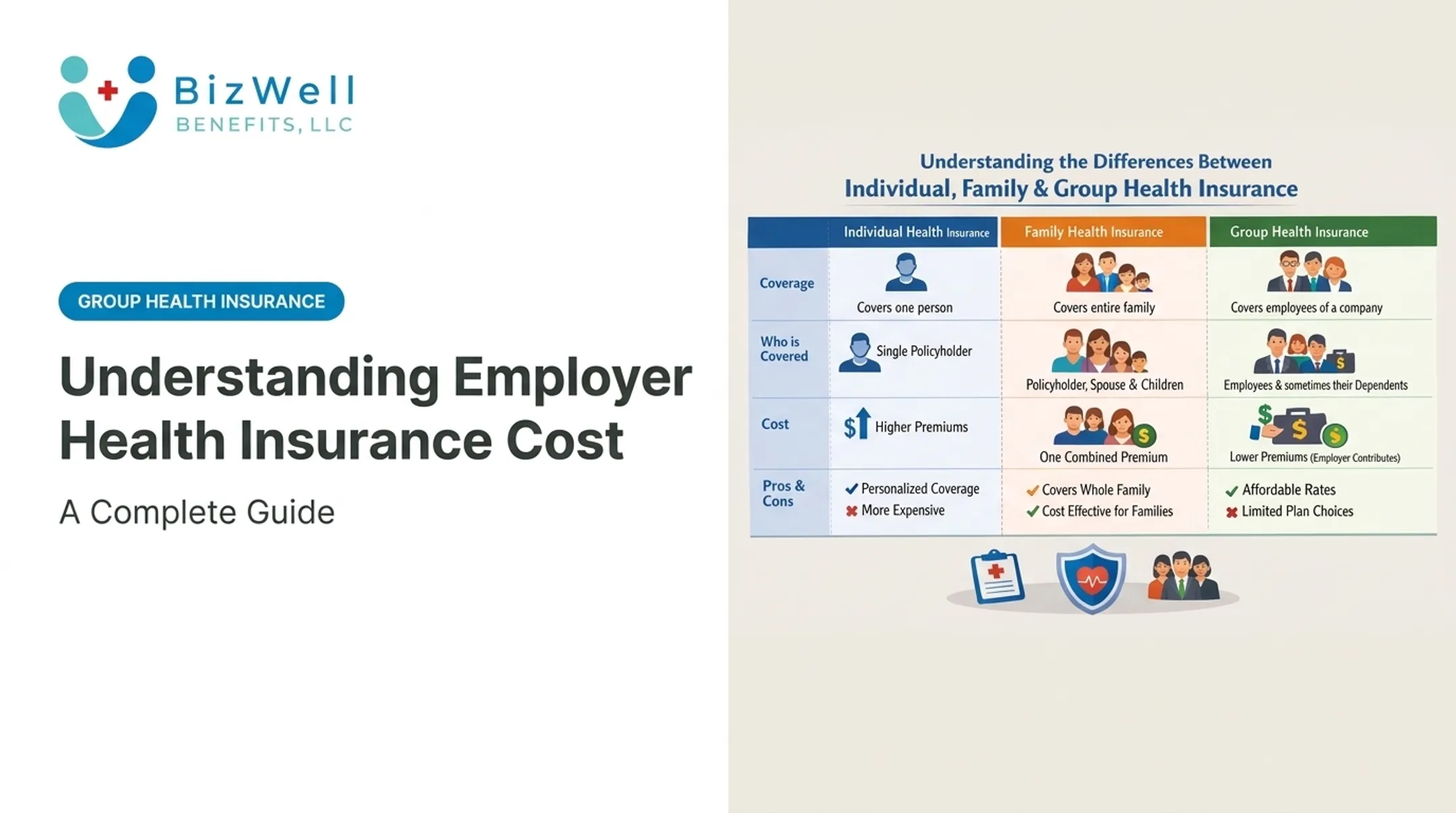
How much does small business health insurance cost? It depends on plan design, your team’s age and location, how much you contribute, and which coverage tiers you offer.
Many owners budget for the monthly premium alone and get caught short. The full picture includes your employer premium share, administrative fees, and the deductibles, copays, and out-of-pocket maximums your employees face—plus optional add-ons when you offer them.
This guide covers current pricing benchmarks, what pushes premiums up or down, how employer and employee costs split, and how to build a realistic budget before you request quotes.
Key Takeaways
- Small-firm premiums average about $768/month for single and $2,171/month for family coverage in 2025.
- Plan type, employee ages, location, and contribution strategy drive most of the cost difference.
- The lowest premium often shifts more cost to employees through higher deductibles.
- Network fit and employee affordability matter as much as the quoted premium.
How Much Does Small Business Health Insurance Cost?
There's no fixed national rate for group coverage. Published averages are planning benchmarks, not a quote for your specific business.
According to the 2025 KFF Employer Health Benefits Survey, small firms (defined by KFF as 10-199 workers) paid average total annual premiums of $9,211 for single coverage ($767.58/month) and $26,054 for family coverage ($2,171.17/month). Workers covered a portion of that themselves, roughly 16% for single coverage and 36% for family coverage.
That leaves an average employer-paid share of about $647.58/month for single coverage and $1,430.42/month for family coverage. About 29% of small-firm workers were in plans where the employer covered the entire single premium.
Typical Cost Range
Small-group coverage usually falls into three tiers:
- Entry-level plans: Narrower networks, higher deductibles, and more cost-sharing, including HDHPs that often suit younger teams focused on major-medical protection.
- Mid-range plans: The most common structure for small groups. These balance monthly premiums against provider access, moderate deductibles, and manageable copays.
- Higher-cost plans: Broader PPO access, richer benefits, lower cost-sharing, and family enrollment push costs up; statewide or nationwide PPOs usually cost more than limited local options.
Published cost ranges usually reflect medical premiums alone. They typically exclude dental and vision coverage, broker compensation, wellness program fees, HRA administration, and the employee-paid share deducted from paychecks.
Illustrative example: Say a 10-employee company contributes the KFF-benchmarked $647.58/month toward each employee-only premium. That's roughly $6,476/month, or about $77,700 annually, if all 10 employees enroll in employee-only coverage and the employer covers 100% of that tier.
If four of those employees add family coverage and the employer's policy only subsidizes the employee-only rate, those four workers absorb the difference between the family premium and the employer's fixed contribution through payroll deductions. Same benchmark, very different real-world budget depending on enrollment mix.

Key Factors That Affect the Cost of Small Business Health Insurance
Insurers and brokers weigh several variables together, not premium alone, when pricing a group plan. Plan design, participant demographics, location, and your contribution approach all interact.
Plan Type and Network Design
- HMO: Lower premiums, but requires a primary care physician and referrals, with coverage limited to in-network providers except emergencies.
- EPO: Similar to an HMO structurally, but skips the referral requirement. Still limited to network providers.
- PPO: Broader access, no referrals needed, and out-of-network care is available (at a higher cost). Premiums run higher in exchange for that flexibility.
- POS: A middle ground: lower in-network costs, but a referral is needed to see a specialist.
- HDHP: Lower monthly premiums with a higher deductible, often paired with an HSA. 2025 KFF averages: $8,620 single and $25,379 family, below the overall small-firm average.
A nationwide PPO network appeals to businesses with employees spread across multiple cities, but availability and pricing vary by state and carrier. "Nationwide" doesn't guarantee every provider is in-network at every location — always verify.
Workforce Size, Age Mix, Location, and Enrollment
Federal small-group rating rules limit how much age can swing your premium: no more than a 3:1 ratio between the oldest and youngest adult, and 1.5:1 for tobacco use. Health status, gender, and industry can't be used as rating factors at all under ACA small-group rules.
Geography matters too. States set rating areas by county, ZIP code, or metro region, and some states (New York is one example) use community rating that spreads risk across the entire pool regardless of age or health status.
Family enrollment changes your total cost picture even when your contribution policy only covers the employee-only tier. More dependents enrolling means a bigger gap for employees to cover out of pocket.
Employer Contribution Strategy
How much you pay toward each premium shapes both your budget and your team's perception of the benefit. Common approaches include:
- Fixed percentage: you pay a set share (say, 75%) of every employee's premium, regardless of which plan they pick.
- Fixed dollar amount: you contribute a flat dollar figure per employee; anything above that comes from their paycheck.
- Reference-plan contribution: you fund a baseline plan fully, and employees who choose pricier options pay the difference.

Paying a larger share increases your direct expense but tends to improve participation and how employees value the benefit.
Coverage Level and Cost-Sharing
Premium and point-of-care costs move together. The main levers are:
- Premium
- Deductible
- Copay and coinsurance
- Out-of-pocket maximum
A lower-premium plan generally means employees pay more when they use care. Plans richer in prescription coverage, mental health services, telehealth, or maternity benefits usually carry higher premiums, but those extras can matter a lot for satisfaction and retention.
Eligibility, Compliance, and Available Credits
Cost design also sits next to eligibility rules and tax credits that can change your net spend.
Businesses with fewer than 50 employees aren't legally required to offer coverage, but many do to stay competitive on hiring.
If you're considering the Small Business Health Care Tax Credit, IRS Form 8941 instructions set these 2025 thresholds:
- Fewer than 25 full-time equivalent employees
- Average annual wages below $67,000 per FTE
- Uniform employer contribution of at least 50% of each enrolled employee's employee-only premium
The credit phases out above 10 FTEs and disappears entirely at 25. It is only available for two consecutive tax years, and coverage generally needs to run through the SHOP marketplace. Confirm current eligibility with a tax professional before assuming you qualify.
Cost Breakdown and Low-Cost vs. High-Cost Plans
Your total cost isn't just the recurring premium. It includes how cost-sharing gets split, administrative requirements, and what happens at renewal.
Premium Contributions
Employers and employees each pay a piece of the premium. A simple way to estimate your annual employer cost:
Eligible employees × employer's monthly contribution × coverage months = annual employer cost
If family enrollment applies and your contribution policy only covers the employee-only tier, add the employee-side gap separately. That gap doesn't reduce what you owe, but it affects what your team actually takes home.
Deductibles, Copays, Coinsurance, and Out-of-Pocket Maximums
A lower premium plan often means employees shoulder more cost when they use care. A higher premium can reduce that exposure at the point of service.
After a deductible, many plans split remaining costs. A common structure is the plan paying 80% and the member paying 20% coinsurance until the out-of-pocket maximum is reached.
Per HealthCare.gov's out-of-pocket maximum guidance, 2025 federal out-of-pocket limits for ACA-compliant plans reach up to $9,200 individual and $18,400 family, rising to $10,600 and $21,200 for 2026. These caps apply to employer-sponsored coverage as well as Marketplace plans. They generally cover deductibles, copays, and coinsurance for in-network, covered services. Premiums, non-covered services, and out-of-network balance billing don't count.

Additional and Periodic Costs
Budget for these beyond the base premium:
- COBRA or continuation administration (federal COBRA generally applies to employers with 20+ employees)
- HSA or FSA administration fees
- Employee communication and enrollment support
- Renewal adjustments and plan changes
- Optional dental or vision coverage
Low-Cost vs. High-Cost Coverage
| Factor | Lower-cost plan | Higher-cost plan |
|---|---|---|
| Monthly premium | Lower | Higher |
| Provider access | Narrower network | Broader, often nationwide PPO |
| Deductible | Higher | Lower |
| Employee cost exposure | Higher when care is used | More predictable |
| Best fit | Younger, price-sensitive team | Team needing broad access or family coverage |
A leaner plan can work well for a younger, healthier workforce focused on catastrophic protection. A richer plan makes more sense when employees value predictable costs, broader networks, or family coverage. Don't pick a plan solely because it has the lowest premium. Check the provider directory, formulary, expected utilization, and worst-case exposure first.
How to Estimate the Right Budget for Small Business Health Insurance
Start with your goal. Are you prioritizing minimum-cost compliance, recruiting and retention, broad provider access, or a balanced package? That answer shapes everything downstream.
Before you request quotes, pull together:
- Employee census (ages, ZIP codes, dependents) and expected enrollment
- Current benefits, if any
- Preferred doctors and hospitals
- Prescription needs across the team
- Desired plan type and target employer contribution
- Desired effective date and renewal timing
- Tax or accounting questions for a qualified professional
Build at least two scenarios: a lower-premium design with higher employee cost-sharing, and a richer design with a higher employer contribution. Compare annual employer cost, estimated employee cost, and network suitability side by side.
Compare these coverage options:
- SHOP marketplace plans: Generally available to employers with 1-50 full-time equivalents. Participation requirements may be waived during the November 15-December 15 enrollment window.
- Traditional group coverage: The most common path for small employers, with the employer setting the contribution level.
- ICHRA: Lets employers of any size reimburse individual coverage tax-free if at least one non-owner employee is included. Affordability rules affect whether employees can also claim Marketplace tax credits.
Insurers price by market area, so quotes can differ meaningfully even for similar benefits. An independent broker like BizWell Benefits can compare options across multiple carriers and help you weigh plans against your workforce needs, budget, and network preferences without steering you toward one carrier.
What Most People Miss When It Comes to Cost
- Focusing only on the employer premium while ignoring employee affordability, family coverage costs, and participation requirements
- Comparing plans with different networks or benefit designs without normalizing premium, network, and cost-sharing together
- Underestimating renewal increases, admin workload, and how a weak plan can hurt recruiting and retention
- Assuming an LLC structure, tax credit, or reimbursement arrangement automatically saves money. Confirm specifics with a licensed insurance professional and tax adviser before counting on it

Conclusion
Small business health insurance costs depend on workforce composition, location, plan design, enrollment mix, employer contribution, and the benefits you select. There's no shortcut around that variability.
The right budget balances your monthly expense against employee affordability, provider access, expected healthcare use, and long-term retention value — not just the number on the first quote you receive.
Before you commit:
- Gather your employee census and plan preferences
- Compare at least two coverage structures side by side
- Get personalized guidance on cost and fit
BizWell Benefits offers a free consultation for Texas employers working through exactly this decision.
Frequently Asked Questions
How much do small businesses pay for health insurance?
Small firms averaged $767.58/month for single coverage and $2,171.17/month for family coverage in total premiums in 2025, per KFF. Employers typically covered $647.58 and $1,430.42 of those amounts, respectively.
Is $500 a month normal for health insurance?
It depends on what the $500 represents. As an employer contribution toward single coverage, it's plausible but below the 2025 small-firm average employer-paid amount of about $648/month.
Can my LLC pay for my health insurance?
Your options hinge on business structure, tax classification, and whether you have employees. Partners and S-corp shareholders face different IRS reporting rules, so confirm your situation with a tax professional and licensed insurance adviser.
How do most small business owners get health insurance?
Options include traditional group plans, SHOP marketplace coverage, individual coverage for owners without employees, and reimbursement arrangements like ICHRA. The right fit depends on your headcount and goals.
Is health insurance cheaper for business owners?
Not automatically. Group purchasing doesn't guarantee lower prices. Affordability depends on plan design, your contribution level, tax treatment, and available credits.
What is the best health insurance for small business owners?
There's no universal answer. The best plan depends on your budget, provider network needs, and employee demographics. Compare multiple carriers and designs rather than assuming one plan fits every business.