
It's a real tension. You want to attract good employees, but you also can't let a health plan eat your margins. Add in employee questions about deductibles, networks, and dependents, and the whole process starts to feel overwhelming.
This guide breaks down what group health medical insurance actually is, how it works day-to-day, the main plan types available, and how to evaluate your options as a U.S. small-business owner. We'll also cover alternatives worth considering and what to do when you're ready to choose.
Key Takeaways
- Group coverage pools employees under one policy and typically stabilizes pricing versus individual plans
- Premiums are usually shared; your contribution structure directly drives participation
- Network rules and cost-sharing matter as much as the monthly premium
- Match the plan to your workforce’s age, location, and healthcare needs
What Is Group Health Medical Insurance?
Group health insurance is medical coverage an employer (or another eligible organization) purchases for a group of employees, typically under a master policy or group contract. The employer is the policyholder. Employees who meet eligibility rules enroll as members under that single agreement.
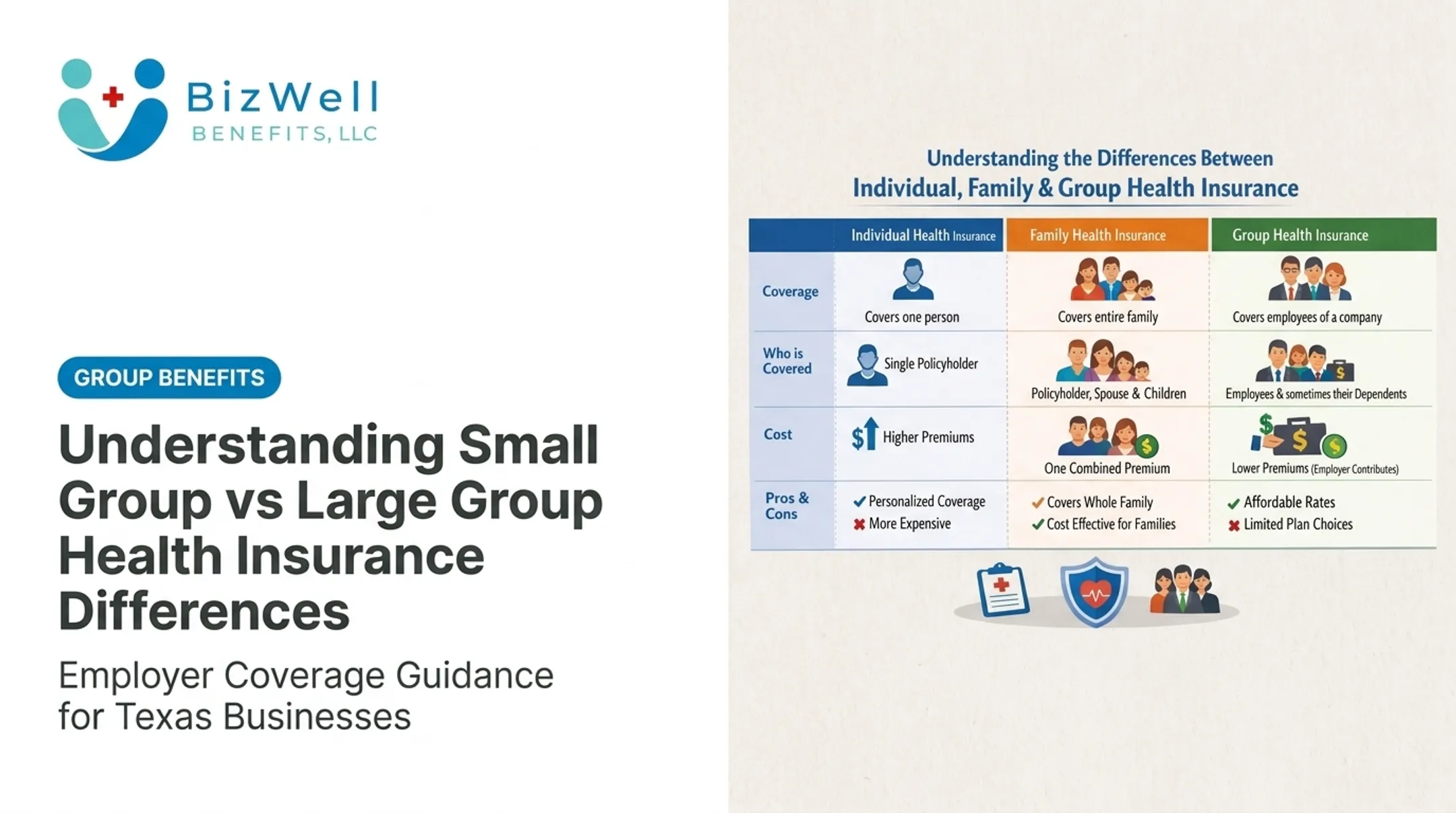
This is different from an individual or family plan a person buys on their own. With group coverage:
- The employer selects the plan(s) offered, not each individual employee
- Premium costs are usually split, with the employer contributing a set amount and employees covering the rest through payroll deductions
- Enrollment happens through the employer, generally during a defined window or new-hire period
Group medical insurance is also distinct from supplemental benefits like dental, vision, life, or disability coverage. Many businesses bundle these into one benefits package, but they're separate products with separate rules.
Why Risk Pooling Matters
Group coverage works because it spreads expected medical claims across many people instead of pricing each person individually. The American Academy of Actuaries notes that pooling offsets the higher costs of less-healthy members with the lower costs of healthier ones, and larger pools generally make premiums more predictable and stable over time.
Actual pricing still depends on the carrier, your location, the plan design you choose, and your group's characteristics—pooling helps, but it does not guarantee low rates.
Terms Every Small-Business Owner Should Know
Know these terms before you compare quotes:
- Premium – the amount paid monthly (or another interval) to keep the plan active
- Deductible – what employees owe before the plan starts paying for covered services
- Copayment – a fixed dollar amount paid at the time of service
- Coinsurance – the employee's percentage share of costs after the deductible is met
- Out-of-pocket maximum – the most an employee pays in a plan year for covered care
- Provider network – the doctors and hospitals contracted with the plan
- Formulary – the plan's list of covered prescription drugs
How Group Health Insurance Works for a Small Business
Setting up group coverage is a multi-step process with several moving pieces. Understanding the sequence helps you avoid surprises.
The Typical Process
- Assess workforce needs – how many employees, their ages, dependent status, and rough healthcare usage patterns
- Request quotes from multiple carriers or work with a broker who can pull several at once
- Compare plans across premiums, deductibles, provider networks, and out-of-pocket limits
- Select an effective date and complete enrollment paperwork
- Manage ongoing renewals and any qualifying life-event changes throughout the year

Eligibility and Waiting Periods
Carriers set eligibility rules based on job classification, full-time or part-time status, and how long someone has worked for you. Federal rules cap any elapsed-time waiting period at 90 days for plan years beginning on or after January 1, 2014.
Participation minimums are a separate requirement. Confirm current carrier rules, since thresholds vary by plan and state.
How Premium Contributions Typically Work
In most small-group plans, you pick a contribution strategy, often a flat dollar amount or a percentage of the employee-only premium. The employee covers the remainder through payroll deduction. Dependent premiums are usually separate and often paid entirely by the employee unless you choose to subsidize them too.
Your contribution level directly affects how affordable coverage feels to employees. Many small groups start by covering about 50% of the employee-only premium. A low contribution can technically satisfy "offering benefits" while still leaving participation rates disappointing.
What Employees Receive
Once enrolled, employees typically get:
- An ID card for accessing in-network providers
- Coverage for preventive services under plan rules
- Prescription drug coverage tied to the plan's formulary
- Claims processing and explanation of benefits (EOB) statements
Employer Responsibilities Don't End at Enrollment
Running a group plan means ongoing work:
- Distributing plan documents
- Processing new hires and terminations
- Reconciling monthly invoices
- Answering employee questions
- Protecting sensitive employee data
Brokers often absorb this administrative load on the employer's behalf.
When someone leaves your company or has a qualifying event like divorce or a dependent aging out, you may need to offer continuation coverage. Federal and state continuation rules differ, so confirm current requirements before communicating anything to a departing employee.
Comparing Group Medical Plan Types and Costs
Not all group plans work the same way. The network model you choose shapes both cost and flexibility.
| Plan Type | How It Works | Best For |
|---|---|---|
| HMO | Defined network, primary-care coordination, referrals often required for specialists | Teams prioritizing lower premiums over provider flexibility |
| PPO | Broader provider choice, partial out-of-network coverage at higher cost | Employees who travel or want nationwide access |
| EPO | In-network care only, no out-of-network coverage except emergencies, no referral requirement | Groups that want simple in-network care without referral hurdles |
| POS | Blends HMO and PPO features with primary-care coordination | Groups wanting some flexibility with cost control |
Cost Components Beyond the Premium
The monthly premium is just one number. Also compare:
- Deductible amount and whether it's per-person or per-family
- Copay and coinsurance structure
- Out-of-pocket maximum
- Prescription drug tiers
- Employer contribution percentage
- Dependent premium costs
- Expected renewal increases
The Premium-vs-Exposure Tradeoff
A lower-premium plan often shifts more cost onto employees when they actually use care. Picture two plans: one with a modest monthly premium but a high deductible, and another with a higher premium but a lower deductible.
The "cheaper" option on paper can cost an employee more in a bad health year. Neither choice is automatically wrong—the tradeoff just needs to be clear before you decide.
Nationally, average annual premiums for firms with 10-199 workers reached $9,211 for single coverage and $26,054 for family coverage in 2025, according to KFF's Employer Health Benefits Survey. Workers in that segment contributed 16% toward single premiums and 36% toward family premiums on average.

A Quick Comparison Checklist
Before signing anything, check each plan against:
- Preferred doctors and hospitals in-network, including specialists
- Emergency and urgent care coverage
- Behavioral health benefits
- Maternity care coverage
- Prescription drug coverage and tiers
- Coverage for employees who travel between cities
- Dependent coverage options
Tax treatment for small-business health coverage, SHOP marketplace availability, and potential tax credits all involve rules that change periodically. Confirm current details with the IRS and a qualified tax adviser rather than relying on last year's numbers.
Benefits and Limitations of Group Medical Insurance
Group coverage brings real advantages, but it's not automatically the best answer for every employee or every budget.
What Employers Gain
- A structured, professional way to offer benefits
- Potential recruiting and retention advantages
- Shared premium costs instead of covering everything alone
- Centralized enrollment through one carrier relationship
What Employees Gain
- An employer contribution that lowers their out-of-pocket premium
- Access to negotiated group rates
- Options to add spouses, children, and other dependents
- Protection against large medical expenses under the plan's terms
The Real Limitations
Group plans come with tradeoffs too:
- Restricted networks that may not include every doctor an employee wants
- Standardized designs that don't flex for individual preferences
- Rising renewal premiums year over year in most markets
- Payroll costs for employees, even with employer contributions
- Deductibles and cost-sharing that still apply before full coverage kicks in
Small-firm deductibles run higher than those at larger employers. KFF's 2025 Employer Health Benefits Survey shows an average single deductible of $2,631 among small firms, with 53% of covered workers facing at least a $2,000 deductible.
Group coverage isn't universally cheaper or better than individual-market options for every employee. Some workers, particularly those with subsidy eligibility or specific provider needs, may find better value outside the group plan. Communicate the full picture, not just the premium, so employees know what they're signing up for.
Alternatives to Traditional Group Medical Insurance
A single group policy isn't the only route to offering health benefits.
QSEHRA and ICHRA
These reimbursement arrangements let eligible employers help employees buy their own individual coverage instead of enrolling everyone in one group plan.
- QSEHRA applies to employers with fewer than 50 full-time employees that don't offer another group plan. Contribution limits and notice requirements are updated periodically, so confirm current figures before setting one up.
- ICHRA has no employer size limit and can be offered to specific employee classes, but employers cannot offer a choice between a traditional group plan and an ICHRA for the same class of employees.

Both require employees to keep qualifying individual coverage to receive reimbursements. Verify eligibility rules, contribution limits, and compliance requirements before you implement either arrangement.
Level-Funded Plans as a Middle Ground
For groups roughly in the 10-to-100-employee range, level-funded plans offer a predictable monthly payment while the employer accepts some claims risk, protected by stop-loss coverage.
They provide access to broad PPO networks with more contribution flexibility than a fully insured plan, though eligibility varies by carrier.
When an Alternative Makes Sense
Consider stepping outside traditional group coverage if you have:
- A very small or budget-sensitive team
- Employees spread across multiple states
- A fixed employer contribution and want employees to choose their own plan
A Simple Comparison Framework
- Group plan → centralized coverage, shared enrollment process
- HRA-based approach → defined employer contribution, employee picks their own plan
- Individual coverage without an employer arrangement → for people without workplace benefits access
One caution: don't swap regulated group coverage for an informal taxable stipend without mapping the payroll, tax, and nondiscrimination rules first. Those rules are easy to miss and costly to unwind.
How to Choose and Set Up the Right Plan
Once you understand your options, narrowing down a plan comes down to a structured process.
Start With Your Priorities
Before requesting quotes, get clear on:
- Your monthly benefits budget and desired employer contribution
- Retention goals and how benefits factor into hiring
- Where your employees are located
- Expected hiring over the next year
- Your internal administrative capacity
Ask Employees What Matters to Them
You don't need sensitive medical details. Simple questions work fine:
- Do you have preferred doctors or hospitals?
- Will you need dependent coverage?
- Do you travel for work or live in a different city?
- Is dental or vision important to you?
Compare Apples to Apples
Request quotes using the same employee census, effective date, and contribution strategy across every carrier. Otherwise, you're not really comparing plans, you're comparing assumptions.
Build a simple scorecard weighing:
- Total employer cost and employee payroll cost
- Deductibles and out-of-pocket maximums
- Network quality and prescription coverage
- Plan exclusions and participation rules
- Renewal history and carrier service support
Build an Implementation Timeline
Work backward from your target effective date and assign owners for each step:
- Select the plan and lock contribution strategy
- Draft employee communications and FAQs
- Open enrollment and issue required notices
- Set up payroll deductions and carrier feeds
- Go live, then document how you'll handle enrollment corrections
An independent broker helps most at quote comparison and rollout. BizWell Benefits compares group health options across multiple carriers for small businesses with 2 to 49 employees and medium-sized groups up to 100-plus. Founder and licensed healthcare agent Katherine Nguyen helps business owners sort PPO, HMO, EPO, and level-funded choices against real headcount, locations, and budget.

Making a Confident Group Health Insurance Decision
Group medical insurance can strengthen your ability to hire and keep good people, but the lowest premium on the page isn't automatically the best deal for your team.
Weigh your decision against these priorities:
- Match coverage to employee needs across your workforce
- Balance employer contribution against total cost
- Confirm provider access and plan design fit
- Meet compliance duties for your group size
- Plan for ongoing administrative support
Before finalizing anything, review your current plan documents closely and talk with a licensed insurance professional and a qualified tax or legal adviser. Rules around eligibility, continuation coverage, and tax treatment shift, and getting current guidance matters more than following last year's playbook.
If you're a small-business owner in Texas trying to sort through group health options, BizWell Benefits offers a free, no-pressure consultation with an independent licensed healthcare agent. Call 713-352-7573 or reach out at info@bizwellbenefits.com to compare your options side by side.
Frequently Asked Questions
What is considered a group health plan?
A group health plan is medical coverage an employer or eligible organization purchases for a group of members under a single policy. Eligibility and participation rules vary by carrier and group size.
What is the most popular type of group health plan?
No single type leads the market; it depends on employer size and location. HMOs trade lower premiums for tighter networks, PPOs cost more for broader access, EPOs skip referrals but stay in-network, and POS plans blend both.
What is an example of a group health plan?
A small business with 15 employees buys one medical policy from a carrier. Eligible employees then enroll themselves and dependents during the plan's enrollment window.
Which group health insurance is best?
There's no universal "best" plan. It depends on your budget, workforce needs, provider networks, and cost-sharing structure. Compare total value across plans rather than premium alone.
What type of insurance is used for group plans?
Group plans can include employer-sponsored medical insurance along with separate group dental, vision, life, or disability coverage. This article focuses specifically on group medical insurance.
What are the benefits of group insurance?
Group insurance typically means shared premium costs, centralized enrollment, recruiting value, and dependent coverage options. Tradeoffs include network restrictions and standardized plan designs.