
Introduction
Group health insurance is usually the single largest line item in a small business benefits budget. It's also one of the most reliable ways to keep good employees from walking out the door. Balancing those two realities gets harder every renewal season.
Many business owners struggle to answer a simple question: how much should this actually cost?
According to SHRM's 2026 Employee Benefits Survey, 88% of employers rate health-related benefits as "very important" or "extremely important" to their workforce. Pricing that benefit correctly still trips up business owners and HR teams alike.
There's no single price tag here. Your total cost depends on group size, who actually enrolls, plan design, where your employees live, provider network breadth, your contribution strategy, and your insurer's own rules.
This guide breaks down current national benchmarks and what employers and employees typically pay. It also covers the factors that move premiums up or down, the hidden cost-sharing expenses employers often miss, and how to build a realistic budget.
Key Takeaways
- 2025 KFF averages: $9,325 single / $26,993 family total premiums; employees pay about $1,440 and $6,850.
- Costs shift based on plan type, workforce age, location, enrollment tiers, and how you structure contributions.
- Lower premiums usually mean higher deductibles, narrower networks, or bigger out-of-pocket exposure.
- Balance affordability with employee access — not just the lowest monthly premium.
How Much Does Group Health Insurance Cost?
Group health insurance is employer-sponsored coverage where the premium is typically split between the business and the employees who enroll. What you budget as an employer each month isn't the same figure as the plan's total premium. Your cost is the total minus whatever employees contribute through payroll deductions.
National Premium Benchmarks
The most current authoritative source is KFF's 2025 Employer Health Benefits Survey, published in October 2025.
| Coverage | Annual Total Premium | Monthly Equivalent | Employee Share (Annual) | Employer Share (Annual) |
|---|---|---|---|---|
| Single | $9,325 | ~$777 | $1,440 | ~$7,885 |
| Family | $26,993 | ~$2,249 | $6,850 | ~$20,143 |
These numbers are national averages: a planning benchmark, not a quote for your specific workforce.
Calculating a Preliminary Budget
A rough formula for your employer budget:
Employer cost = (enrolled employees × tier premium) − employee contributions + administrative or related costs
A 10-person Houston company with six employees on single coverage and four on family plans will land on a very different number than a 50-person company with a mostly family-plan workforce. Group size and enrollment mix change everything.
Fully Insured vs. Self-Funded Arrangements
Two funding structures dominate the small business market:
- Fully insured: You pay a fixed premium; the carrier absorbs claims risk entirely. Predictable, but you don't benefit if claims run low.
- Self-funded (including level-funded): Your monthly payment typically covers three pieces: estimated claims funding, administrative fees, and stop-loss protection. Level-funded plans can be attractive for groups of roughly 10 to 100 employees, though eligibility varies by carrier.
Self-funding isn't the right fit for every small business. A young, healthy workforce may benefit, while a group with unpredictable claims may prefer the stability of fully insured coverage.
Either way, a national average is a starting point, not a proposal. Getting carrier-specific quotes based on your actual workforce, state, and plan preferences is the only way to know your real number.

Key Factors That Affect Group Health Insurance Cost
Several levers drive what you pay for group coverage: who enrolls, how carriers rate the group, which network you choose, how rich the benefits are, and how much the employer contributes.
Group Size, Participation, and Coverage Tiers
Smaller groups usually face tighter underwriting and less rate stability than larger groups. Carriers also often require a minimum percentage of eligible employees to enroll unless they have other qualifying coverage.
Coverage is typically priced across tiers:
- Employee-only
- Employee + spouse
- Employee + child(ren)
- Family
Each tier has its own premium. A workforce heavy on family enrollments will cost more overall than one dominated by employee-only coverage, even on the same plan.
Age, Location, and Rating Rules
Under CMS market rating reforms, individual and small-group premiums may vary by age, tobacco use, family size, and geography. Adult age rating is capped at a 3:1 ratio, and tobacco-use rating is capped at 1.5:1.
States also set geographic rating areas that carriers must apply uniformly. That is why the same plan can price differently across Texas metros.
Plan Type Trade-Offs
| Plan Type | Network Rules | Premium Impact |
|---|---|---|
| HMO | Requires a PCP and referrals; limited network | Lower premium, less flexibility |
| PPO | No referrals; in- and out-of-network access | Higher premium, broader access |
| EPO | No referrals, but network-only | Mid-range premium |
| POS | Referrals required for specialists | Mid-range premium |
| HDHP | Any network design; higher deductible | Lowest premium, more upfront cost |
A statewide or nationwide PPO network almost always costs more each month than a narrower alternative. The trade-off is fewer surprises when an employee needs care outside their home city.
Metal Tiers and Coverage Richness
Bronze, Silver, Gold, and Platinum tiers reflect actuarial value — the share of costs the plan pays versus the member. Richer metal tiers usually mean higher premiums and lower out-of-pocket costs at the point of care.
These federal metal-tier definitions apply to non-grandfathered individual and small-group ACA plans. They do not automatically apply to every large-group arrangement.
Contribution Strategy and Add-Ons
How you split premium with employees shapes both budget risk and participation:
- Fixed-dollar employer contributions keep your cost predictable when rates rise
- Percentage-based contributions rise automatically with premiums and can pressure renewal budgets
- Wellness programs and state-mandated benefits sit outside the core medical premium and need a separate line in the budget

Total Cost Breakdown: Premiums, Contributions, and Out-of-Pocket Costs
Premiums and Employer Contributions
The premium is the recurring amount required to keep the policy active. In most plans, the employer pays a set percentage or dollar amount and the employee covers the rest through payroll deduction.
A common real-world example: a $500 monthly premium where the employer covers 80%. Evaluate your contribution policy for affordability, competitiveness against similar employers, and long-term budget predictability—not only what feels generous in year one.
Employee Cost-Sharing
This is where hidden costs live. Key terms:
- Deductible: What employees pay before coinsurance kicks in. A $5,000 deductible leaves most early-year bills on the employee; a $1,000 deductible starts cost-sharing much sooner.
- Coinsurance: Under an 80/20 split, the plan pays 80% and the member pays 20% of the allowed charge after the deductible.
- Out-of-pocket maximum: Caps annual spending on covered, in-network services. Once it's met, the plan pays 100% for the rest of the year.
Deductibles, copays, coinsurance, and usually prescription costs for covered in-network care count toward that maximum. Monthly premiums do not.
Administrative and Periodic Costs
- Broker or admin fees for enrollment coordination and payroll setup
- Employee communications and compliance support
- Renewal increases: budget roughly 5% annually for inflation, even in a managed-cost scenario
- Dependent enrollment shifts and claims-driven adjustments at renewal
Low-Cost vs. High-Cost Plans
Plan design is a tradeoff between premium and point-of-care cost:
- Leaner plan: Lower monthly bill; higher deductibles, narrower networks, more employee out-of-pocket exposure
- Richer plan: Higher upfront premium; better provider access and more predictable employee costs
Choose based on what your workforce can absorb when people actually use care, not only on the monthly invoice.
How to Estimate the Right Group Health Insurance Budget
Building an accurate budget starts before you request a single quote.
- Profile your workforce. Count eligible employees, estimate participation, identify likely coverage tiers, and separate full-time from part-time eligibility.
- Set your contribution policy first. Decide your target employee-only contribution and whether you'll help with spouse, child, or family coverage before comparing carriers.
- Compare total annual employer cost, not premium alone. Review deductibles, out-of-pocket maximums, networks, formularies, renewal assumptions, and payroll deduction impact side by side.
- Model a renewal scenario. Run at least one status-quo increase and one managed-cost scenario, since renewal increases vary widely year to year.

Comparing multiple carriers and plan designs by hand takes real time. An independent broker like BizWell Benefits can run those comparisons against your workforce needs and budget, without promising a guaranteed premium outcome. A free consultation can clarify what's realistic for your group before you commit to a plan.
What Employers Commonly Miss About Group Health Insurance Costs
Employers often budget for premiums alone and miss the cost drivers below.
- Fixating on the monthly premium. It hides the real impact of deductibles, copays, coinsurance, and out-of-pocket maximums that employees actually feel.
- Chasing the lowest quote. A cheap plan with a restrictive network or narrow prescription formulary can frustrate employees fast, even if the sticker price looks great.
- Skipping renewal modeling. Participation shifts, ancillary benefits, payroll administration, and eligibility compliance can blow up a year-one budget by year two.
- Ignoring employee affordability. Showing employees only the plan brochure, not their actual payroll deduction and likely out-of-pocket exposure, undermines enrollment and trust.
Conclusion
Group health insurance cost varies by workforce, location, plan design, enrollment mix, and contribution policy. National averages are a starting point, but never a substitute for a carrier-specific proposal.
An accurate budget accounts for premiums, employer contributions, employee cost-sharing, administration, ancillary benefits, and renewal risk. The first invoice alone does not tell the full story.
Compare plans on total value and employee needs, not premium alone. An independent broker can help you weigh those tradeoffs across carriers before you commit.
Frequently Asked Questions
How much does group health insurance typically cost per month?
Monthly costs vary by coverage tier, workforce, location, and contribution policy. The 2025 KFF benchmark is about $777/month for single coverage and $2,249/month for family coverage nationally — not an individualized quote.
What is the average cost of group health insurance in the US?
According to KFF's 2025 Employer Health Benefits Survey, average annual total premiums are $9,325 for single coverage and $26,993 for family coverage. Employees pay roughly $1,440 and $6,850 of those totals respectively.
Is group health insurance more expensive than individual health insurance?
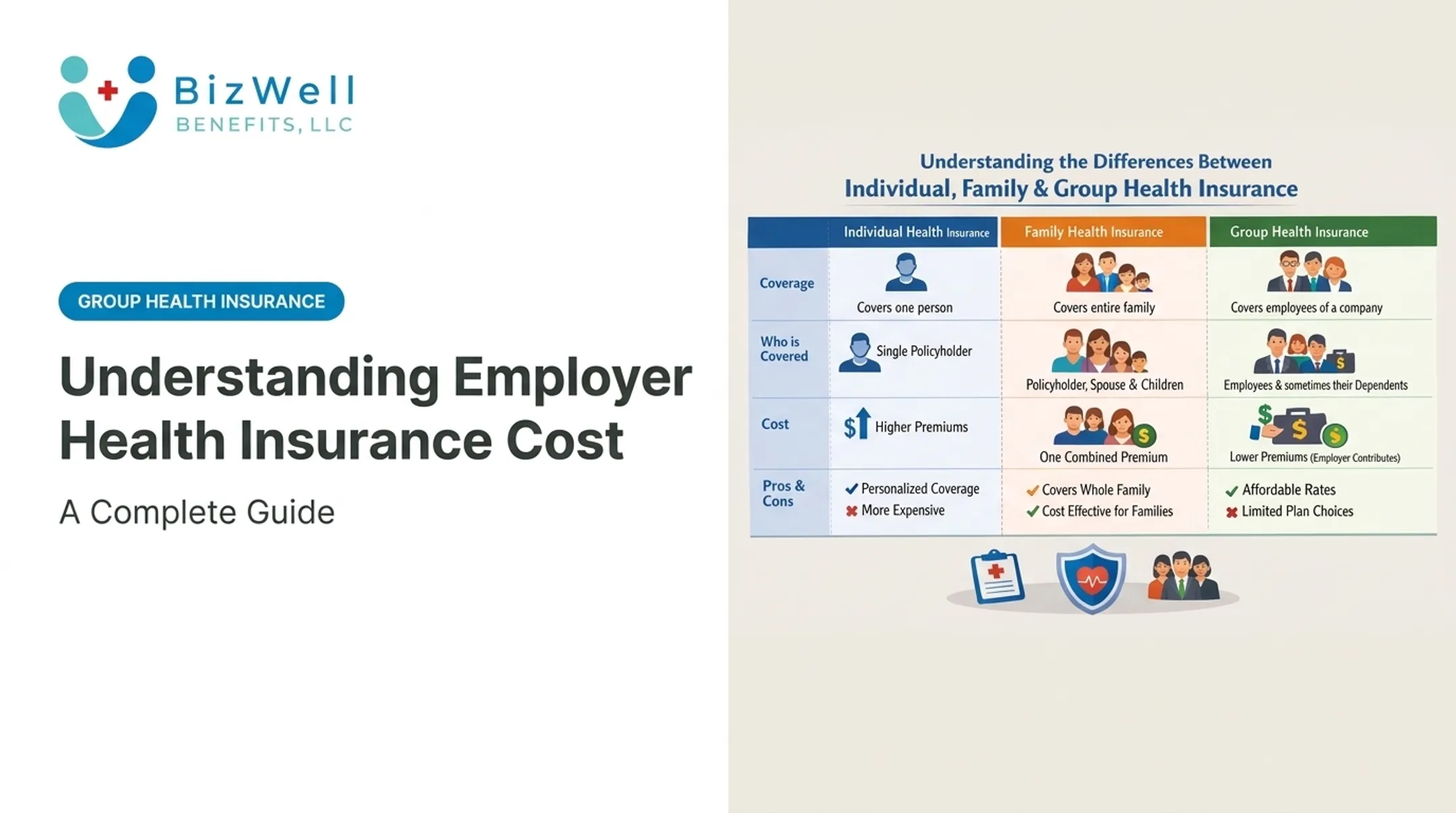
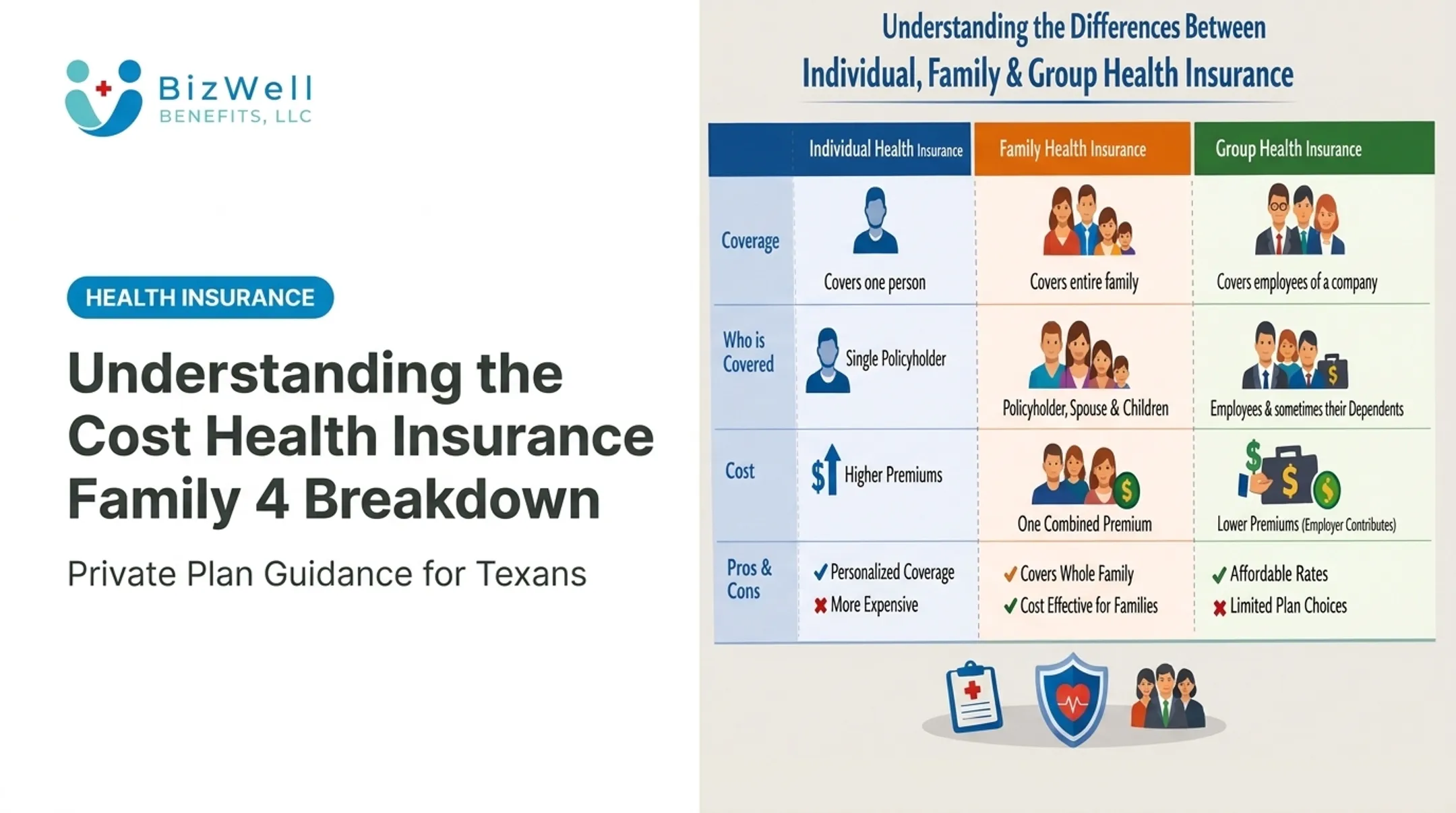
Not always. It depends on plan design, employer contributions, subsidies, and network access. Employer contributions often make group coverage cheaper for the employee, even when the total premium is similar.
What is a group insurance plan?
A group insurance plan is coverage an employer or organization purchases for eligible members as a group. Premiums and cost-sharing follow the plan's rules rather than individual underwriting.
How many people do you need for a group insurance plan?
Minimum participation requirements vary by carrier, state, and group type. Some carriers accept groups as small as two employees; always confirm current requirements before applying.
What is covered in group health insurance?
Most plans cover preventive care, primary and specialist visits, hospital services, prescription drugs, and emergency care. Specific benefits, exclusions, and cost-sharing vary significantly by plan and carrier.